
THE NOBLE PRIZE
The World Forum and Cinema for Peace have established The Noble Prize in 2025 to recognize and celebrate exceptional contributions to the advancement and well-being of humanity. This award seeks to honor individuals and organizations that have made a significant impact in the fields of culture, peace, human rights, justice, science, innovation in technology, and AI - ensuring that those committed to a better world receive the recognition they deserve and may inspire others to follow. The first award was presented to Noble Peace Laureate Narges Mohammadi as Guardian of Democracy who is in Iran Prison in 2024.Despite a similar sounding name, The Noble Award is not associated with Alfred Nobel, who created the Nobel Prize in 1895. The Noble Award does not only reward an extraordinary, best, or unique achievement as for example the Nobel Prize, the Turing Award, the Oscar, or the Emmy, it is also based on having integrity, role model function and high moral and ethical principles.
THE NOBLE PRIZE 2026
CINEMA FOR PEACE & DEMOCRACY GALA 2026 - HONORING THE MOST VALUABLE FILMS OF THE YEAR & THE NOBLE PRIZE FOR GUARDIANS OF DEMOCRACY FOR TAWAKKOL KARMAN, SVIATLANA TSIKHANOUSKAYA, DR. TEDROS & WHO, ALBIE SACHS, LEOPOLDO LÓPEZ, RENÉE GOOD and the PEOPLE OF MINNEAPOLIS
The Cinema for Peace & Democracy Gala 2026 celebrated with honorary chairwoman Hillary Clinton the most valuable films of the year and presented the Noble Prize for Guardians of Democracy for Tawakkol Karman, Sviatlana Tsikhanouskaya, Dr. Tedros & WHO, Albie Sachs, Leopoldo Lopez and Renée Good and the people of Minneapolis, with her widow accepting the award in her first public conversation since the mother of three had been killed by an ICE agent.
"The Noble Prize” as Guardian of Democracy to Tawakkol Karman
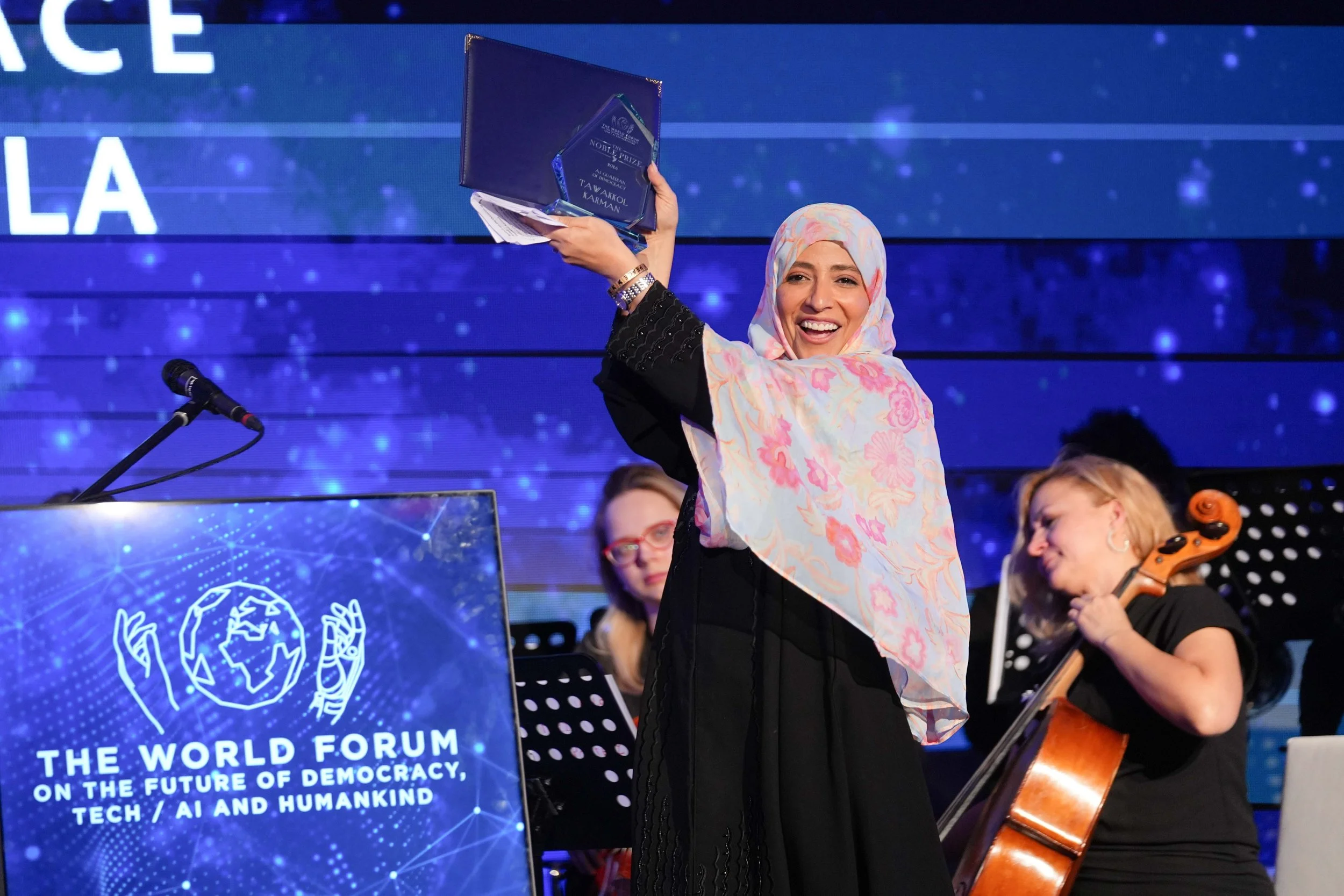
Tawakkol Karman - honored for her non-violent struggle for the safety of women and for women's rights to full participation in peace-building work. A fearless journalist, human rights champion, and founder of Women Journalists Without Chains, she stood firmly for press freedom, civil rights, and the power of non-violent change through her leadership during the Arab Spring. In 2011, she became a co-recipient of the Nobel Peace Prize - the first Arab woman, the first Yemeni, and one of the youngest laureates in history.
"The Noble Prize” to Dr. Tedros & World Health Organisation
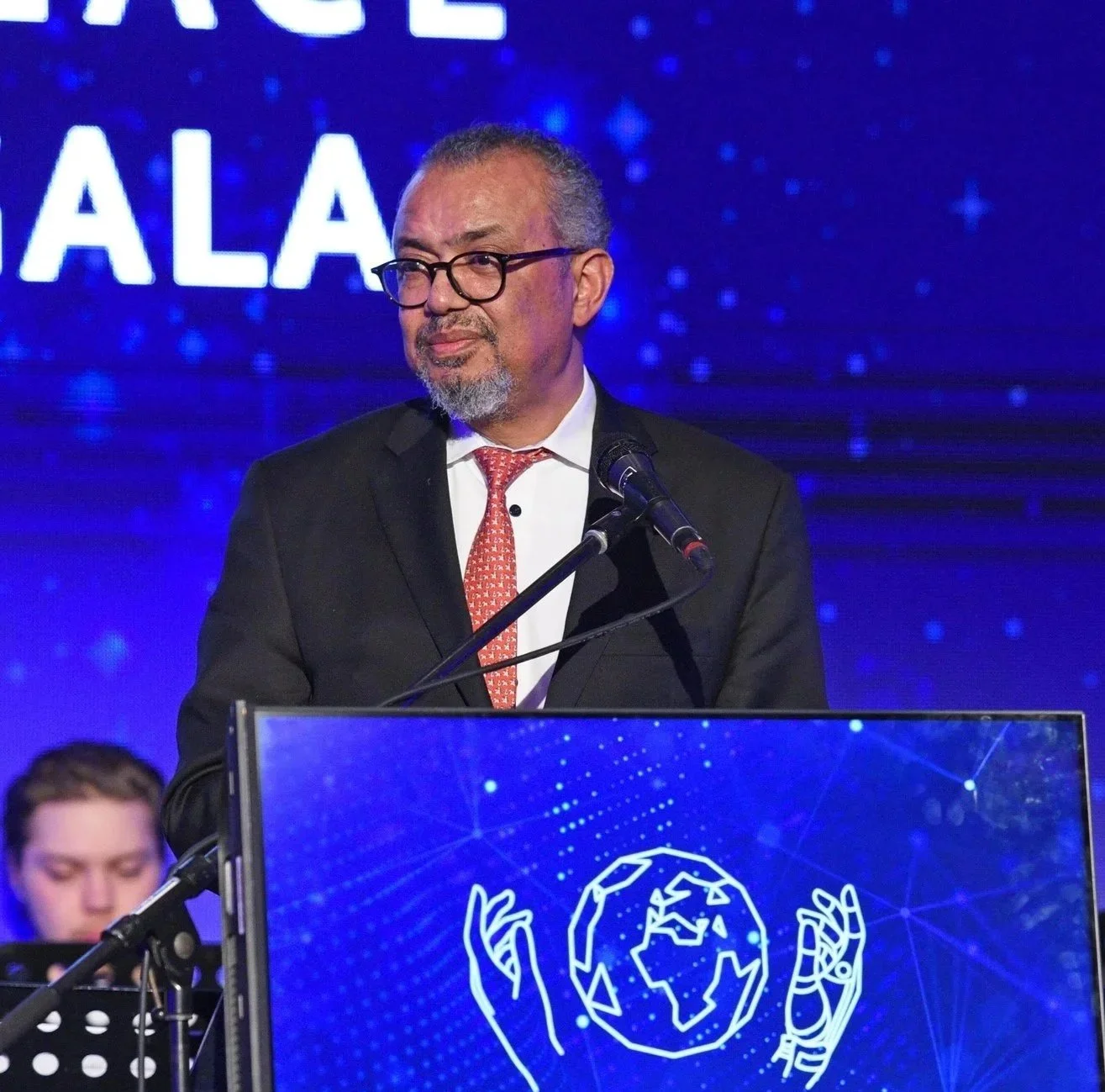
Dr. Tedros Adhanom Ghebreyesus & The World Health Organization - honored for saving hundreds of millions of lives and protecting humanity from the next pandemic. From coordinating responses to Ebola and COVID-19, to expanding access to life-saving vaccines in the world's most vulnerable communities, Dr. Tedros and the WHO represent global solidarity at its most essential.
Dr. Tedros - "After all these traumatic experiences and challenges, I am the Director General of the World Health Organisation. Things change. That is why I remain hopeful, and I hope there will be peace, and our children can grow as children."
"The Noble Prize” as Guardian of Democracy to Leopoldo López & The World Liberty Congress
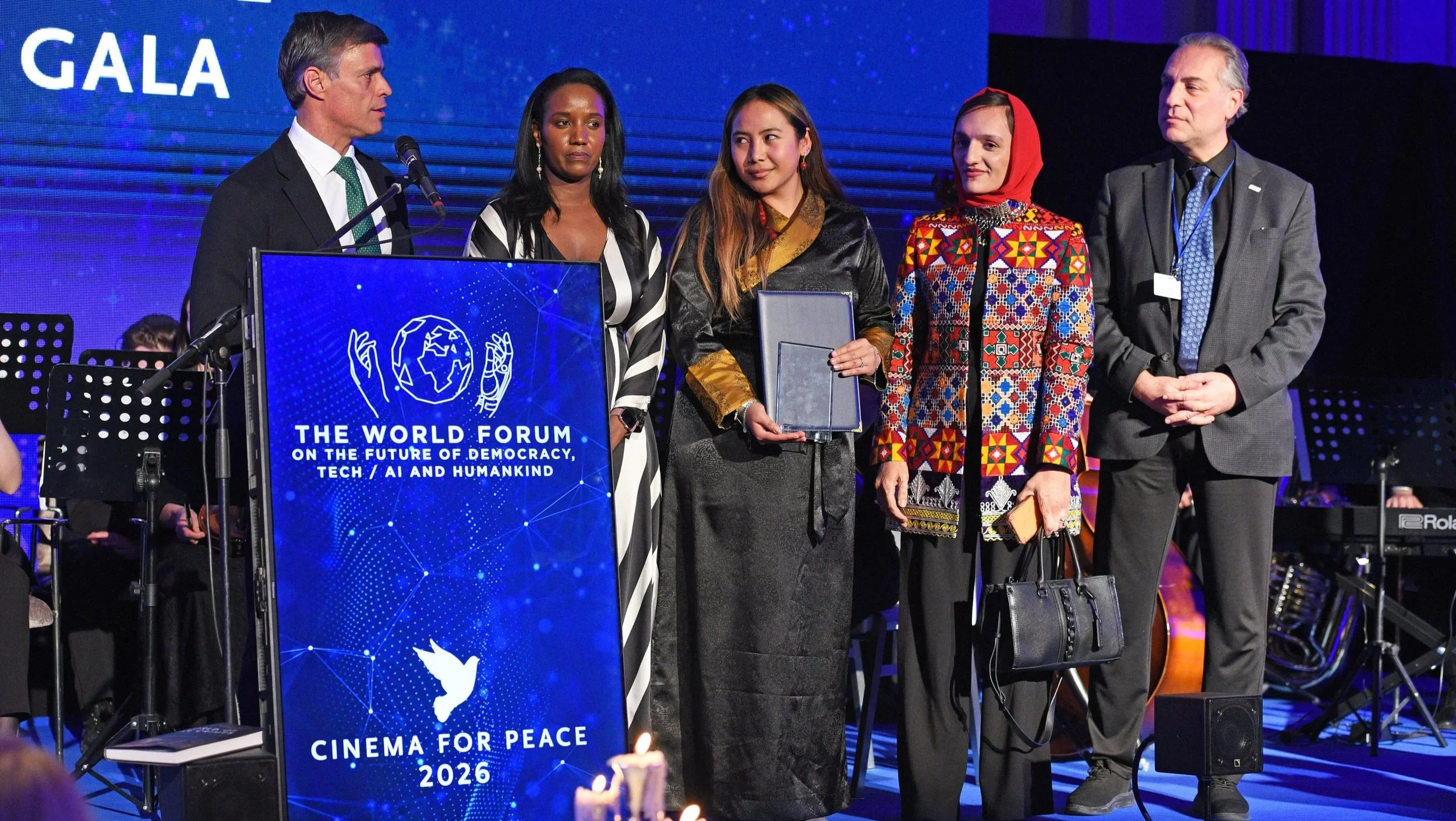
Leopoldo López and The World Liberty Congress - honored for their unwavering defiance of authoritarianism and their work uniting democracy activists across the globe. Venezuelan opposition leader Leopoldo López endured years of unjust imprisonment for his refusal to abandon the cause of democracy. Tonight, the award was presented jointly to him and to The World Liberty Congress, the international movement he helped forge, uniting democracy activists, dissidents, and freedom fighters from across the globe in a shared front against authoritarianism. Their presence in the room together was itself an act of defiance.
Leopoldo López - "I was the mayor of Caracas [Chacao municipality] for 8 years and then I was disqualified to run for office, started a movement, went to the streets, grassroots, and then in 2014, we called for protests. Tens of thousands of people went to the streets, I went to prison... Then I went into exile. Exile is another form of imprisonment for people who love their country, for people who thrive for their country, for people who live and breathe every day to see their country improve."
"The Noble Prize” as Guardian of Democracy to Albie Sachs
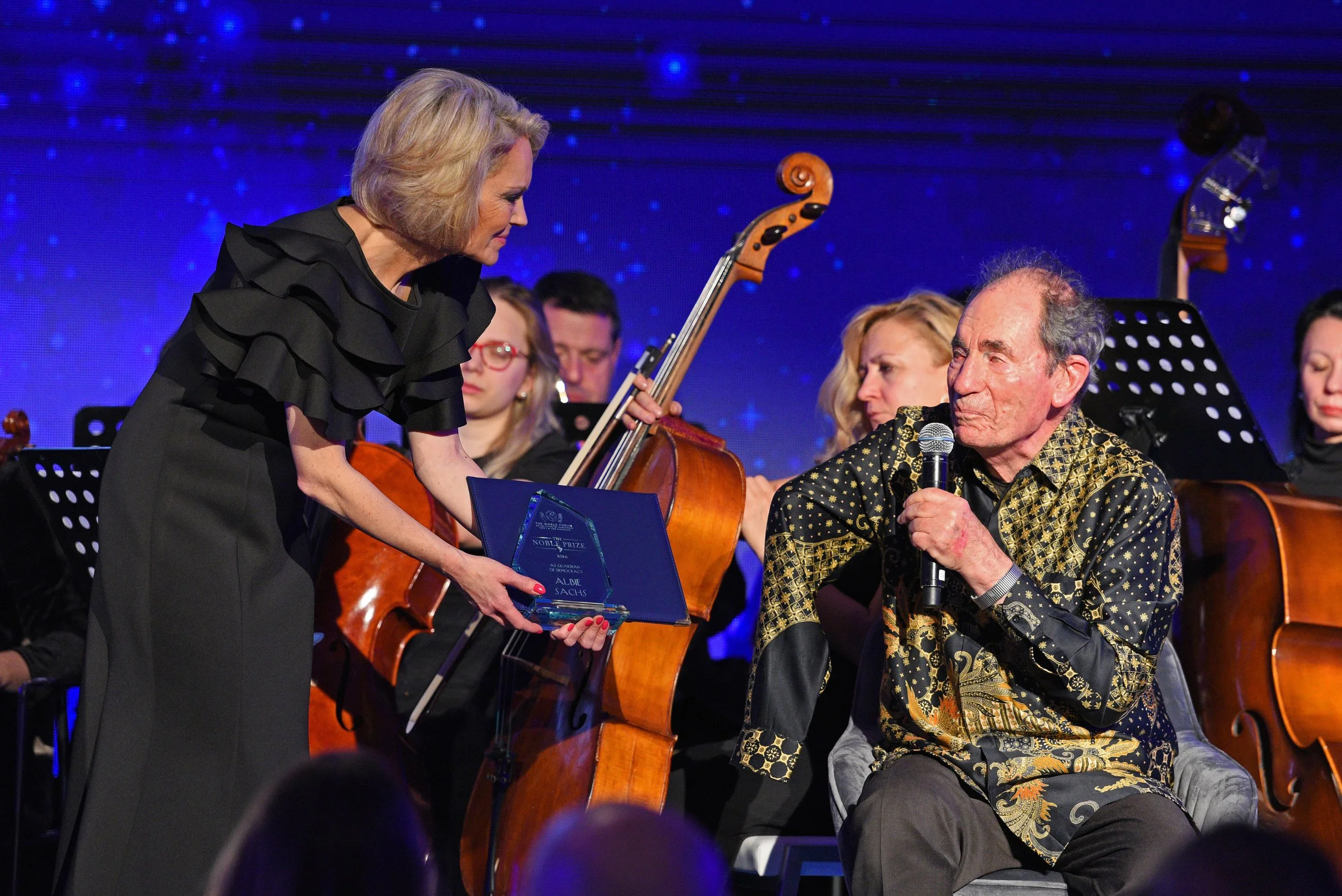
Justice Albie Sachs - honored for his extraordinary commitment to reconciliation and restorative justice. An anti-apartheid activist who paid a devastating personal price for his resistance, surviving a brutal car bombing carried out by the apartheid regime, he chose not to answer violence with vengeance. Instead, he dedicated his life to building a society rooted in dignity, equality, and justice, and helped write one of the most celebrated constitutions in the world.
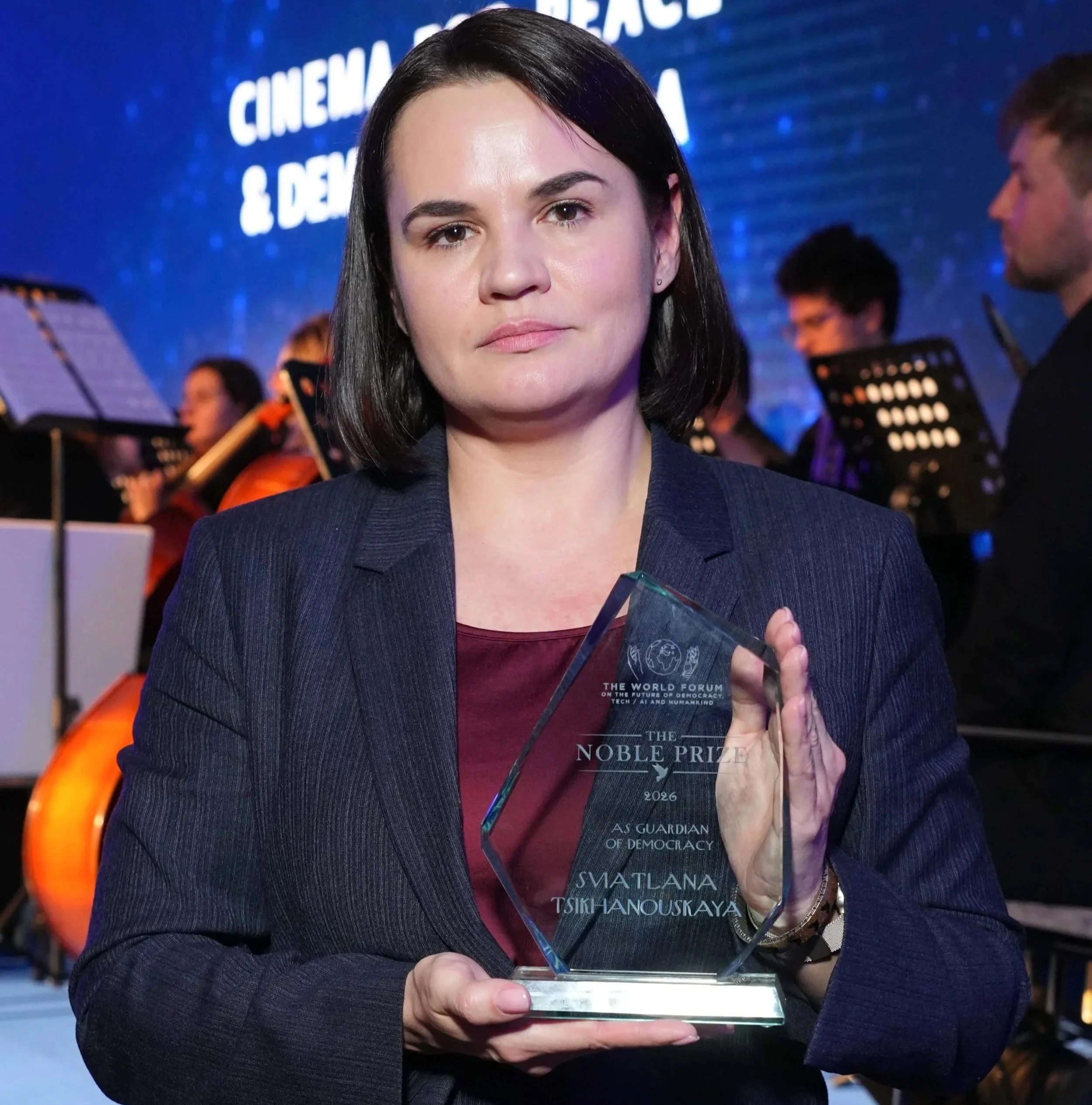
"The Noble Prize” as Guardian of Democracy to Sviatlana Tsikhanouskaya
Sviatlana Tsikhanouskaya - honored for her courageous leadership of the Belarusian democratic movement and her peaceful resistance against the authoritarian regime of Lukashenko. After her husband was unjustly imprisoned for voicing his presidential aspirations, she stepped forward as the main opposition candidate in Belarus's 2020 presidential election. Following a disputed vote and historic mass protests, she was forced into exile, yet refused to let distance silence her voice. From abroad, she continues to champion free and fair elections and democratic reform for her people.
"The Noble Prize” as Guardian of Democracy to Renée Good & People of Minneapolis
And in the most deeply moving moment of the evening, a final honor was dedicated to Renée Good, a mother of three, she was simply taking her six-year-old to kindergarten when she was shot dead by ICE agents in Minneapolis. Her widow, Becca Good, spoke to Cinema for Peace founder Jaka Bizilj in what became her first public conversation since the killing. Hundreds of news outlets, broadcasters, and organizations around the world had asked to speak with Becca. She chose The World Forum and Cinema for Peace.
Founder Jaka Bizilj invoked John F. Kennedy's immortal words - "I am a Berliner" - declaring to the room: “America stood with Berlin in times of greatest danger to our freedom. Now, WE stand with America in its 250th birthday year - and exclaim: We are Minneapolis!"
The Ukrainian State Orchestra had opened the evening with a medley for freedom, comprising the national anthems of the US, Germany, Ukraine, Taiwan, Israel, Palestine and the European Union with Beethoven's Ode of Joy, and closed the evening after the honouring of Renée Good and the people of Minneapolis with Puccini's “Vincerò” from “Nessun Dorma": "I Will Win. We Will Win."
THE NOBLE PRIZE 2025
President Bill Clinton "The Peacemaker of the Century"
US President Bill Clinton was honored at the Democracy Gala on 18 March 2025 in Berlin with “The Noble Prize” as “The Peacemaker of the Century” for ending wars in Bosnia, Kosovo, Yugoslavia, Northern Ireland, Israel/Palestine and East Timor. The Noble Prize as Guardians of Democracy was presented to Vladimir Kara-Murza and Maria Ressa, and The Noble Genius Prize to Prof. David Sinclair, The Noble Prize for Humanity and Global Impact to Richard Branson / Sam Branson.

Heads of State and representatives of Kosovo, Romania, Bosnia, Israel, Palestine, Ireland, Northern Ireland and the representative of Pope Francis deliver laudation remarks for President Clinton as “The Peacemaker of the Century”
"The Noble Prize” as Guardian of Democracy to Vladimir Kara-Murza

Geoffrey Robertson presents "The Noble Prize” as the Guardian of Democracy to the Russian Opposition Leader Vladimir Kara-Murza
"The Noble Genius Prize" to David Sinclair

Philosopher Peter Singer presents "The Noble Genius Prize" to Prof. David Sinclair

The President of Kosovo Vjosa Osmani and former Prime Minister of Israel Ehud Olmert present the Noble Prize to US President Bill Clinton as "The Peacemaker of the Century"
“The Noble Prize” as Guardian of Democracy to Nobel Peace Laureate Maria Ressa

One of the world's leading investigative journalist Carole Cadwalladr presents "The Noble Prize” as the Guardian of Democracy to Nobel Laureate Maria Ressa
"The Noble Prize for Humanity and Global Impact" to Richard Branson / Sam Branson

Pussy Riot presents "The Noble Prize for Humanity and Global Impact" to Richard Branson / Sam Branson
The World Forum and Cinema for Peace have established The Noble Prize to recognize and celebrate exceptional contributions to the advancement and well-being of humanity. This award seeks to honor individuals and organizations that have made a significant impact in the fields of culture, peace, human rights, justice, science, innovation in technology, and AI – ensuring that those committed to a better world receive the recognition they deserve and may inspire others to follow. Despite a similar sounding name, The Noble Award is not associated with Alfred Nobel, who created the Nobel Prize in 1895. The Noble Award does not only reward an extraordinary, best, or unique achievement as for example the Nobel Prize, the Turing Award, the Oscar, or the Emmy, it is also based on having or showing fine personal qualities and high moral and ethical principles.
Noble Peace Laureate Narges Mohammadi Honored as Guardian of Democracy who is in Iran Prison
The "Guardian of Democracy” award was presented at Cinema for Peace Gala 2024 by The World Forum on the Future of Democracy, Tech, and Humankind. Nobel Peace Prize laureate Narges Mohammadi, who is currently imprisoned for her steadfast advocacy against the oppression of women in Iran and her unwavering dedication to promoting democracy, human rights, and freedom for all, was the distinguished recipient of this significant honour. Mohammadi's tireless efforts stand as a testament to the courage and commitment required to confront systemic injustices and champion fundamental human rights. Despite facing severe personal repercussions, including imprisonment, her ongoing advocacy continues to inspire a global audience, underscoring the indispensable role of individual activists in the broader fight for democracy and equality.
The acceptance on behalf of Mohammadi was poignantly delivered through a letter, read by her children, Ali Rahmani and Kiana Rahmani, at the Gala. This emotional moment underscored the personal sacrifices made by champions of democracy and human rights, offering a stark reminder of the ongoing struggles faced by activists worldwide. Mohammadi's words, conveyed by her children, resonated deeply with attendees, serving as a powerful call to action for the international community to support those fighting for democratic principles under oppressive regimes.
Letter from Narges Mohammadi Sent from Prison
Narges Mohammadi
Evin Prison
Tehran, Iran
Cinema For Peace Foundation
Berlin, Germany
February 2024
It is a great honour for me to write from inside the prison for the esteemed "Cinema for Peace" foundation. I am confident that the extensive and concerted efforts of peace activists worldwide will pave a brighter future for humanity.
Extreme actions and extremism threaten peace, often resulting in war. War is commonly associated with fire, explosions, gunfire, and attacks, creating a terrifying image. This makes the search for peace even harder, as it becomes difficult to understand its meaning, possibility, and importance.
War is clearly condemned, and the difficulty and burden of proving its hatred and brutality fall on no one's shoulders.
Allow me to paint a general picture of the situation we are facing, alongside millions of people in the Middle East and in countries governed by authoritarian religious regimes such as the Islamic Republic & the Taliban. In describing this situation, which I certainly do not consider peaceful, to justify the use of the term war, I only refer to two alarming and threatening situations for peace in Iran: sexual apartheid & executions.
Autocracy is the other side of the war coin. To highlight the dirty and infected wounds of autocracy, one needs only to look at the repressive, savage, and tyrannical policies of the Islamic Republic regime. The street massacres of people during protest uprisings and democratic and social movements, including the "Women, Life, Freedom" movement, arrests, torture, imprisonment in solitary cells, and the application of white torture, obtaining forced confessions, and the issuance of heavy prison and execution sentences in unfair and spectacular trials, certainly do not convince any peace advocate of the existence of peace in Iran. The killing of protesters and opponents on the streets, whether by beating or by gunfire on the streets, is just as odious and inflammatory as the killing of innocent people under bombs and missiles. The Islamic Republic regime is aggressive and opposed to the fundamental rights of the Iranian people, and it does not even adhere to its own laws. Is dying at the hands of foreign invading forces, in the sense of war, and dying at the hands of the internal invading and aggressive regime in the sense of peace for 45 years? In my opinion, the land of Iran is governed by a totalitarian and ideological regime that is at war with its people at all times and everywhere. But this unilateral, unstoppable, and ever-growing war against the people advances without a traffic light. Perhaps if an image of the countless and incessant executions were broadcast on television screens, this image-saturated world would tremble on its own, and the outcry against executions, just like the outcry against war in the world, would be heard loud and clear.
In the past year, more than 900 people have been hanged. Every day, before the sunrise call to prayer, silent and defenseless groups are led to the gallows. How tragic and disturbing that no image of these deadly explosions tarnishes the memory of any human being in any dark corner of the planet.
The authoritarian religious government has reached the most unbearable level of economic situation, the most disastrous social crisis situation, and the lowest cultural level. A situation that is unlike that of war-torn lands.
Respected members,
Recently, in a letter to the Secretary-General of the United Nations, I requested that the United Nations condemn the sexual apartheid of women in Iran and Afghanistan to save them from the misogynistic authoritarian religious regime. The regimes of the Islamic Republic and the Taliban, with their authoritarian and religiously tinted nature, have instituted systematic and institutionalized discrimination that enjoys strong support from targeted laws and policies, have created a unique and unknown direction, and have imposed submission, erasure, and elimination of women in their most complex and unimaginable forms at all levels of private and public life.
As a woman, witnessing sexual apartheid in my country, Iran, not as a document collector to prove in court, but clearly as a woman who has experienced this crime against humanity, I declare that despite sexual apartheid, lasting peace will be impossible and will be faced with insoluble and internal contradictions. Similarly, democracy, ethics, freedom, and equality are meaningless in the absence of women's human rights and equality, and in a situation of domination, discrimination, and repression that is meaningless.
I also testify loudly and clearly that the devastating and destructive suffering of millions of women in the Middle East, especially in Iran under the Islamic Republic regime, and in Afghanistan under the Taliban regime, will remain eternally dirty and infected on the human conscience. In the face of our suffering, do not remain silent.
I thank the president and the honorable members of this prestigious international institution for the award of a very important prize, and I ask you, as members of the artistic and cultural community who play a crucial role in shaping and growing global public awareness for peace, not to abandon the Iranian people and the women of the Middle East, especially in Iran and Afghanistan, and clearly with your artistic and cultural contributions, to place the issue of executions and sexual apartheid to achieve democracy, freedom, equality, and lasting peace at the center of global public awareness.
We are standing, and we will continue to fight to overthrow the misogynistic religious regime of the Islamic Republic. I am convinced that the Iranian people will prevail, and you will hear the chant of our victory in the streets of our cities.
Narges Mohammadi