
The End of Sickness and Death by 2040?
Preventing Future Pandemics
In one of the World Forum 2026's most consequential sessions, WHO Director-General Dr. Tedros Adhanom Ghebreyesus, former German Federal Health Minister Dr. Karl Lauterbach, longevity pioneer Dr. Aubrey de Grey, lifestyle medicine founder Dr. Dean Ornish, former Robert Koch Institute President Prof. Dr. Lothar Wieler, Matter Bio's Dr. Samim Sharifi, filmmaker Miguel Morillo, and moderator Jamie Metzl confronted a single underlying question: how do we extend healthy human life, and what systemic failures are shortening it? The panel's verdict on pandemic preparedness was sobering - technically better, politically worse. While the WHO Pandemic Agreement, the Pandemic Fund, the Berlin Hub for Pandemic and Epidemic Intelligence, and the mRNA Technology Transfer Programme in South Africa represent genuine progress, Lauterbach warned that politicisation, eroding trust in science, and the US withdrawal from the WHO have left the world less prepared than it was in 2020. Tedros pointed to transparency as the missing foundation: without honest data-sharing - including on Covid-19's origins - no governance architecture can prevent the next pandemic, with excess mortality estimates already reaching 20 million deaths. The panel identified two underweighted risks reshaping the threat landscape: climate change, with a 25% probability of AMOC collapse, and AI-enabled bioweapons, where tools like AlphaFold now allow small groups to design novel pathogens beyond the reach of any existing surveillance system.
The conversation then turned to what Ornish called "the ongoing pandemic" - chronic disease, which kills more people globally than AIDS, tuberculosis, malaria, and Covid-19 combined. Drawing on 46 years of randomised controlled trials, Ornish demonstrated that a whole-foods plant-based diet, moderate exercise, stress management, and social connection can not only prevent but often reverse coronary heart disease, early-stage Alzheimer's, prostate cancer, hypertension, and type 2 diabetes - while lengthening telomeres and altering gene expression. De Grey pushed the frame further: aging itself kills 20 million people every six months and should be treated with the same urgency the world mobilised for Covid. His central insight - that reversing aging through damage repair is more achievable than slowing it - was reinforced by Sharifi's work on centenarian genetics and species like the Greenland shark (400 years) and bowhead whale (200 years), which have evolved enhanced DNA repair mechanisms that science can now study and translate. Metzl framed the entire discussion as one interconnected challenge: "If we have weaknesses anywhere, we have weaknesses everywhere."
The panel converged on ten calls to action: ratify and fund the WHO Pandemic Agreement with its Pathogen Access and Benefit Sharing annex; dramatically increase the WHO's flexible funding (currently just 14%, with the entire annual budget equal to the cost of a single B-2 bomber); establish binding international biosafety standards modeled on the IAEA's nuclear safeguards; integrate climate policy into pandemic preparedness; deploy lifestyle medicine at population scale; mobilise Covid-scale urgency for aging research; depoliticise health science structurally, not just rhetorically; impose investment penalties on AI companies that fail to prevent biosecurity misuse; ensure longevity technologies are universal rather than a luxury; and — in Ornish's closing words — measure success not by length of life but by its quality. With suicide rates up 36% over twenty years, the panel's most humanistic insight was that biological longevity without meaning is not the goal. Quoting Viktor Frankl, Ornish reminded the audience that those who have a "why" can bear almost any "how." Tedros closed with the line that has come to define the World Forum's mission: "In this very divided and divisive world, our best immunity is solidarity."
“The next pandemic is not a question of if—but when.”
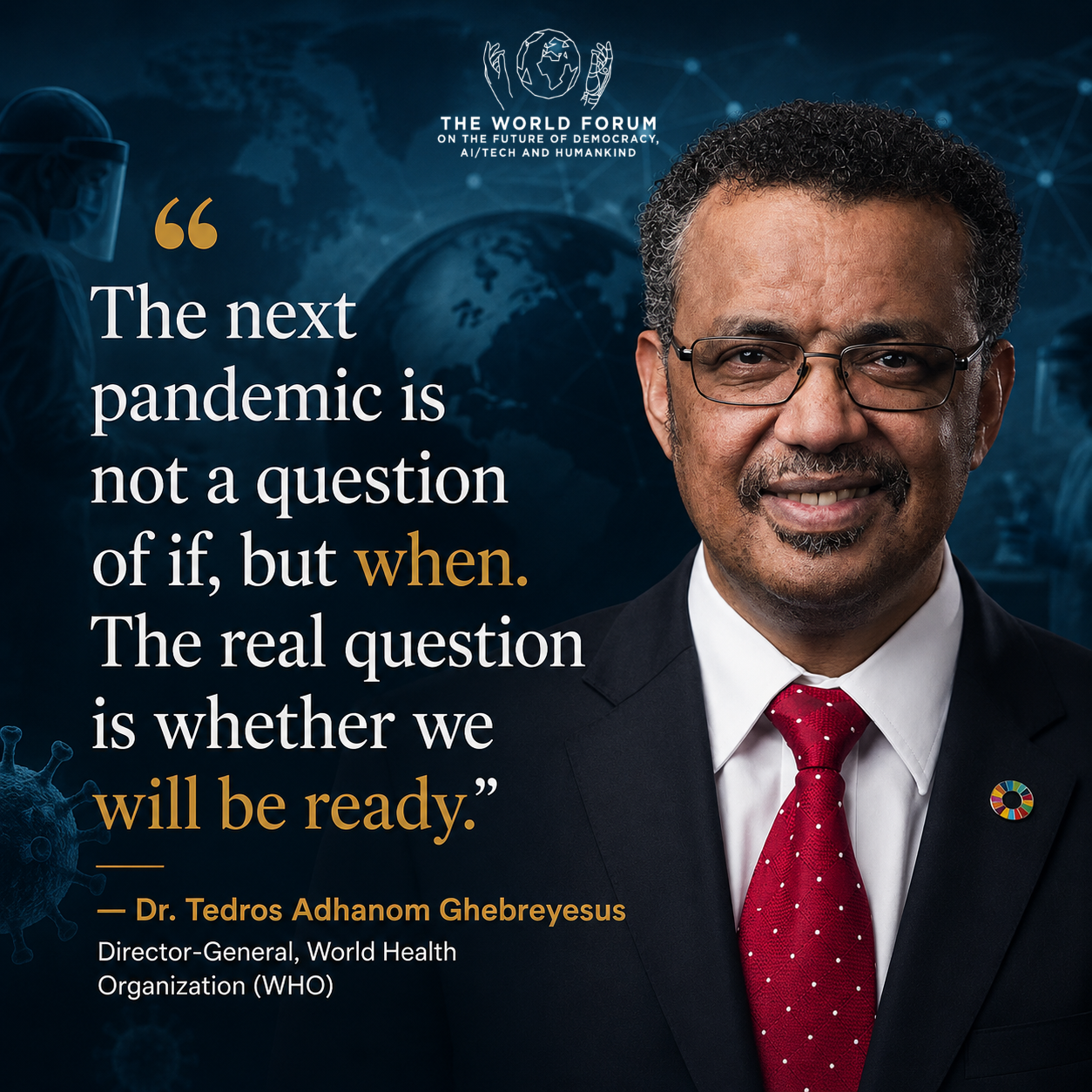
Speaking at the World Forum 2026 in Berlin during the panel "The End of Sickness and Death by 2040? – Preventing Future Pandemics," Dr. Tedros Adhanom Ghebreyesus, Director-General of the World Health Organization, said the world is better prepared for future pandemics—but not prepared enough.
He highlighted progress including the WHO Pandemic Agreement, the Pandemic Fund, AI-powered epidemic surveillance, and expanded vaccine technology sharing. Yet he warned that preparedness ultimately depends on global cooperation, transparency, and trust.
His strongest message was that the biggest threat during COVID-19 wasn't only the virus—it was the politicisation of public health, which undermined science, divided societies, and cost lives.
If the next pandemic is inevitable, are we doing enough to prevent the next global crisis?
The Global Health Bible
The Global Health Bible is the flagship publication of the World Forum on the Future of Democracy, AI/Tech and Humankind, offering a comprehensive vision for the future of human health in an era of unprecedented scientific and technological transformation. Bringing together evidence-based medicine, frontier research, and forward-looking policy perspectives, it examines how advances in artificial intelligence, biotechnology, longevity science, precision medicine, and global cooperation can improve health outcomes, extend healthy lifespan, and strengthen resilience for generations to come.
Covering the full spectrum of human health, the publication integrates the latest scientific evidence, established standards of care, and emerging innovations across disease prevention, diagnostics, clinical medicine, mental health, regenerative medicine, nutrition, environmental health, pandemic preparedness, and healthy aging. It also explores the ethical governance of transformative technologies—including AI, genomics, and neurotechnology—while addressing the global challenges of biosecurity, health equity, and international collaboration. Designed as a trusted reference for policymakers, healthcare professionals, researchers, educators, and informed citizens, The Global Health Bible serves as a practical and visionary roadmap for building a healthier, more resilient, and more sustainable future for humanity.
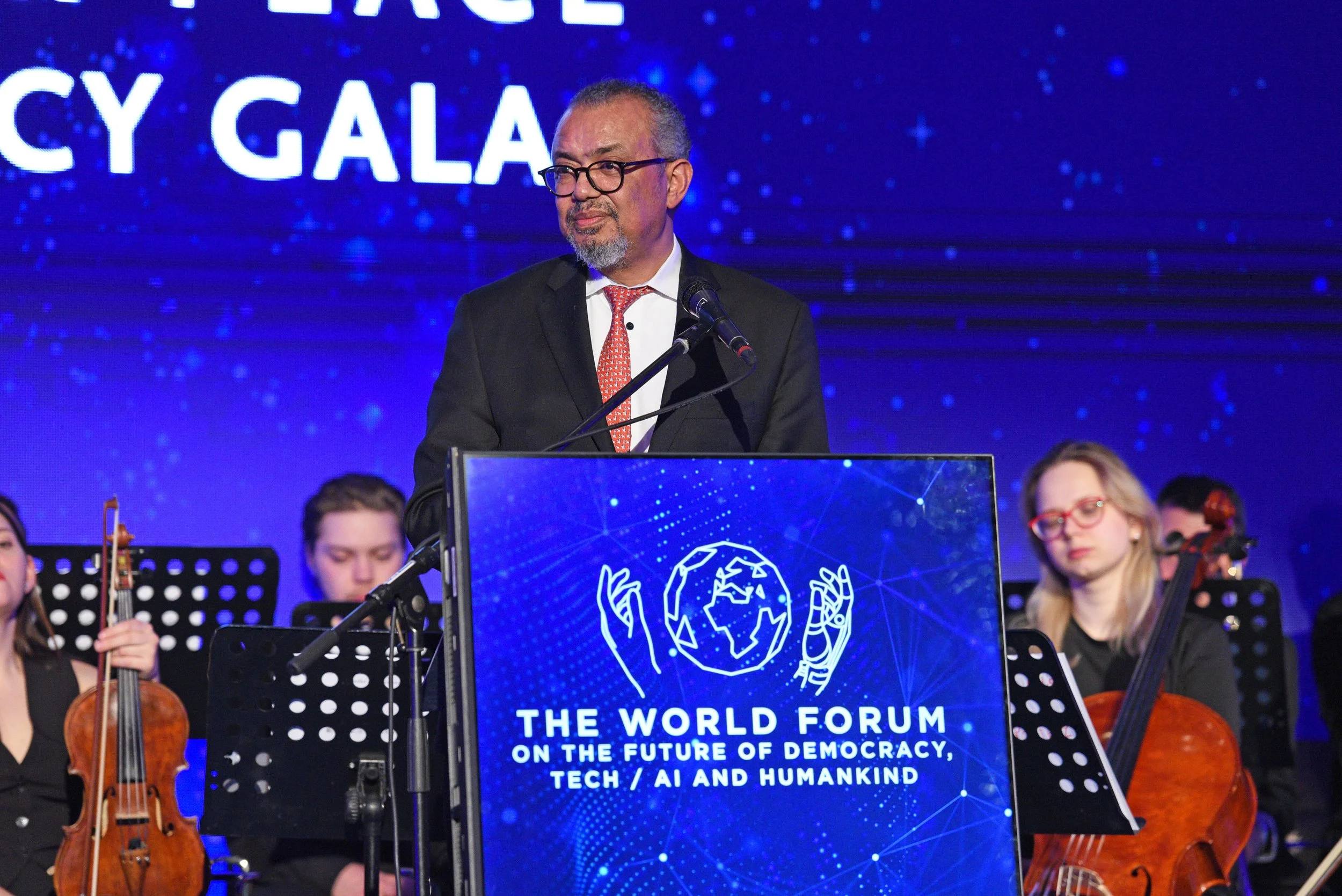
"The Noble Prize” to Dr. Tedros & World Health Organisation
Dr. Tedros Adhanom Ghebreyesus & The World Health Organization - honored for saving hundreds of millions of lives and protecting humanity from the next pandemic. From coordinating responses to Ebola and COVID-19, to expanding access to life-saving vaccines in the world's most vulnerable communities, Dr. Tedros and the WHO represent global solidarity at its most essential.
Dr. Tedros - "After all these traumatic experiences and challenges, I am the Director General of the World Health Organisation. Things change. That is why I remain hopeful, and I hope there will be peace, and our children can grow as children."
The Case for a World Health Council: A Blueprint for Human Longevity
By Prof. David A. Sinclair, A.O. Ph.D. & Jaka Bizilj
The United States recently announced their withdrawal from the World Health Organization (WHO) and the Global Alliance for Vaccines and Immunization (GAVI).
Experts warn this withdrawal severely weakens global disease surveillance, cooperation between nations to solve the greatest of health problems, and the deployment of medicines to treat both chronic diseases and the next pandemic.
The past decade has been defined by revolutionary medical progress, advances in artificial intelligence and energy production and storage, and a global pandemic wake-up call. Now, humanity stands at a crossroads. Will we succumb to a rising anti-intellectualism and continue to combat health crises in silos, reacting after problems emerge? Or will we reimagine global health as a collaborative, proactive mission to protect life and extend healthy lifespans for all?
This shift is not only achievable but, given declining fertility rates and the unsustainable rise in healthcare costs, is essential for sustaining global prosperity.
A Call to Greatly Extend the Human Lifespan
Lifespan has risen steadily but is now threatened due to increases in the cost of healthcare, poor health, funding cuts, and the continuation of 20th Century medical practices. Global health systems remain fragmented and irrational. Diseases, treatments, and standards vary wildly between countries.
Over the past 120 years, average global life expectancy has more than doubled, from ~32 years in 1900 to over 70 in 2021 (link). Over the next century, we may be able to double it again, while ensuring those gains are healthy productive. Guided by advances in AI, we increasingly have the tools to prevent disease, slow aging, and even reverse biological decline.
Lifespan has risen steadily but is now threatened due to increases in the cost of healthcare, less cooperation between nation states, poor nutrition, research funding cuts, and the continuation of outdates medical practices. Source: UN WPP (2024); HMD (2024); Zijdeman et al. (2015); Riley (2005); OurWorldinData.org/life-expectancy
Yet these breakthroughs remain fragmented and fragile: access is uneven, standards differ, research funding is being terminated. Meanwhile, healthcare costs are projected to continue their steady climb, consuming roughly one-third of U.S. GDP by 2050 (Link). Making matters worse, by ignoring aging, these gains in lifespan merely delayed andin some cases extended the suffering. Consider that on average, with access to the best medical technology, Americans spend of 12.4 years living with disease or disability at the end of their lives (link).
We must change course.
The Proposal: The World Health Council (WHC)
We propose the creation of a World Health Council, a diverse, non-partisan global body to rethink human health. Its mission: to cure disease, react to health emergencies, and extend the best years of our lives. The WHC would complement, not overlap with existing institutions like the WHO, GAVI, UNICEF and national ministries. It would be singly focused on extending health span, the years of life lived in good health, free from chronic disease and disability.
The group would act as a global think tank and advisory body to researchers, doctors, enterprises, and nations, by fostering the aggregation of data, promoting the discovery cures, and prioritizing the long-term for the benefit of our species and the systems that support us in ways no single country could achieve alone.
The goal would be a world where every individual, regardless of geography or wealth, has access to facts, health education, clinically proven medicines, nutritious food, untainted science-backed supplements, and intelligent systems. To succeed, the WHC must earn implicit trust built on principles grounded in scientific integrity, reproducibility, data security, and political independence.
Medicine: From Reactive to Regenerative
20th-century medicine was reactive, treating disease after symptoms appeared. With new technologies that can detect diseases we’re entering a new era comparable to the antibiotics revolution, with predictive, preventive, and regenerative capabilities. Today, AI and biosensors can detect diseases up to a decade before symptoms start.
We also know that up to 80% of heart disease, type 2 diabetes, stroke, and many cancers are preventable through lifestyle-diet, exercise, sleep, clean environment (link). Yet health systems still reward treating the resulting disease rather than the cause. The WHC would make prevention the norm, issuing global, evidence-based guidelines for nutrition, movement, and supplements, while responsibly evaluating emerging therapies like stem cells and plasma exchange.
The WHC would support education campaigns, teaching how everyday habits shape biology decades ahead. A single additional year of healthy life in the US is valued at $38T (link). We could gain five or more years of healthy life expectancy per person in a decade (link), saving trillions in healthcare costs globally, freeing up capital for education, medical research, paying down debts (link).
Health with a Sense of Purpose and Holistic Approach
Health is not only physical, our emotional and social well-being matter immensely. Studies show a 46% lower mortality risk among those with a strong sense of purpose (link) and close social relationships predict long life (link). Because well-being must be treated as an integral pillar of health policy, we propose that the WHC include philosophers, psychologists, ethicists, and spiritual leaders to embed emotional resilience, creativity, social bonds, and lifelong learning.
A Globally Trusted Group
The WHC would act as an advisory group to aid nations in their decision making, including advice and consensus on:
Early pandemic detection and response
Ethical frameworks for gene editing, AI health tools, and human enhancement
Safety standards for radiation, toxins, forever chemicals, microplastics and other pollutants based on scientific evidence
Funding for antibiotic development and treatment of neglected diseases
Regulating nutraceutical quality and encouraging proofs of efficacy
Investments in infrastructure and education, especially in underserved regions
Contingency planning for existential threats, including biosphere refuges on Earth and off-world settlements.
We call for a governing body and a $100 billion global investment in preventive research that promotes healthy lifespan and enhances global and national bio-preparedness, with each nation contributing at least 2% of GDP to preventive healthcare and 1% to medical science in order to reduce the overall cost of healthcare from 10% in the European Union and 18% in the USA in 2024 to 7.5% in the next decade due to a much lower number of patients, much lower costs of therapies and the use of AI and AI doctors.
Reducing Costs, Expanding Equity
Every life has value. And every added year of health is a gift. The benefits of extended healthspan must reach everyone, not just a fortunate few. But most of these new life-extending and life-saving technologies are not cheap. Genetic and CAR-T cancer therapies, for example, cost between $400,000 and $1M. These costs can and must come down considerably and be available to everyone, like aspirin and antibiotics.
There are clear ways to slash the cost of healthcare: via regulatory reform lowering the barriers to drug development, the use of AI on individuals, in companies, and at a national level, and the automation of production and supply lines. The Council could coordinate the formation of a shared global database of anonymized health data to accelerate discovery and ensure investments in this sector benefit not just shareholders but the public too.
The WHC could speed drug development by 50–90%, savings that would be passed on to insurance companies, governments and patients. They could champion innovations and new regulations. F[DS4] or example, clinical trials could begin earlier with the use of AI to model animal experiments, and treatments could be tested earlier with “Expanded access” and “Right-to-Try” laws, as we’ve recently seen in the US (link). These changes would ultimately lower drug costs and encourage clinical trials to be performed in labs with experience and scientific rigor (link).
A Call to Action
For the first time in history, the tools to extend healthy lifespan at scale exist. What we lack are coordination, vision, and a collective will. The WHC would serve as the foundational architecture to unite innovation, collate anonymized data, advise on ethics, fund collaborative projects, and strive for equities across nations.
We believe that extending human vitality is not a luxury, it’s a collective opportunity that will save as much money as it would save lives. Rarely is there such a win-win for our species. Now is the time to build a world where every birth carries not just a “right to life”, but the promise of the longest, healthiest, most meaningful life possible.
That’s a future worth working on.
Prof. David A. Sinclair is a Harvard Professor, entrepreneur, and author of the international best seller, Lifespan: Why We Age & Why We Don’t Have to.
Jaka Bizilj is a German-Slovenian writer, film and cultural producer, philanthropist, and founder of the Cinema for Peace Foundation as well as The World Forum on the future of Democracy, AI/Tech and Humankind