
Berlin Becomes Global Capital of Democratic Resilience
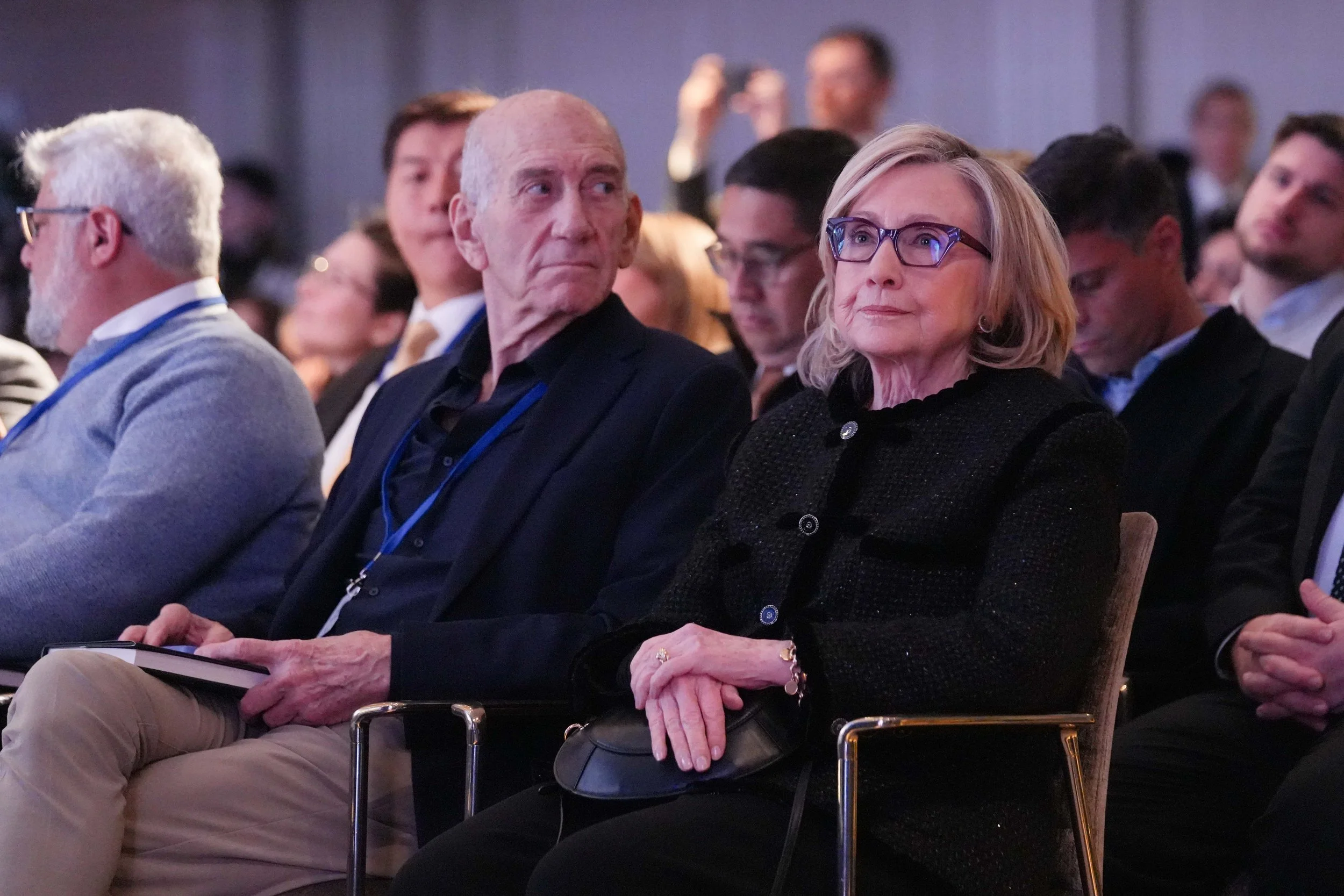
Secretary Hillary Clinton in her keynote noted that autocracies now outnumber democracies for the first time in 20 years, and that nearly three quarters of the world's population today lives under autocratic regimes. She named Putin as the primary instigator of Europe's authoritarian wave - with money flowing from Russian oligarchs into European political parties - and called out Elon Musk for addressing far-right parties in Germany and the UK. She linked the broken information ecosystem directly to Cambridge Analytica, Russian interference, and hundreds of millions of manipulated Facebook interactions, arguing these made Brexit and Trump's 2016 election possible. "A post-truth world is not a world I want to live in - and by definition, it makes democracy impossible."
Jaka Bizilj, founder of The World Forum & Cinema for Peace, reminded that only Russian interference and the mass manipulation of social media - especially through Cambridge Analytica - gave in 2016 Trump the US presidency instead of Hillary Clinton, and connected in his opening remarks unregulated social media and AI with the global democratic erosion and threats to our freedom: "We experience the most exciting, but also the most dangerous period in human history - we have to make everyone aware and set new rules for humankind." He revealed that board member David Sinclair received FDA approval for reprogramming cells in humans - potentially marking the beginning of ending sickness and death. He noted that Donald Trump has cut US military and humanitarian support to Ukraine by 99% in 2025, and announced Inter-Parliamentary Support for the freedom of Taiwan with 10 concrete measures. He also announced the development of The World Forum Council on AI and Social Media, including "The Ten AI Commandments" and advocated in response to the speeches of Marco Rubio and JD Vance at the Munich Security Conference, who had invited for the first time fascists from the AfD this year, to build an alliance based on democratic and humanistic values: "Values are all we have, and it's what defines our freedom."
Dr. Tedros Adhanom Ghebreyesus, Director-General of WHO, reminded that the Covid-19 pandemic killed an estimated 20 million people and wiped more than $10 trillion USD from the global economy - more than any war in recent memory - yet the world forgot within years. He drew direct connections between conflict and disease: Polio reemerging in Gaza 25 years after its last case, and outbreaks of measles, dengue, malaria, diphtheria, and cholera erupting in war-torn Sudan. "There is no health without peace, and no peace without health." Dr. Tedros pointed to a hard-won breakthrough: after more than three years of intensive negotiations, WHO Member States formally adopted by consensus the world's first Pandemic Agreement at the World Health Assembly in 2025 - a legally binding framework designed to ensure the world is never again caught as unprepared as it was by Covid-19. But the agreement requires ratification by at least 60 countries to enter into force, a process that will not begin until a separate annex on pathogen access and benefit-sharing is finalised and adopted - scheduled for the World Health Assembly in 2026.
Board member of The World Forum Geoffrey Robertson KC, one of the world’s leading human rights lawyers and mentor to Amal Clooney and Prime Minister Keir Starmer, presented the book “World of War Crimes”, which he published with The World Forum in order to give a definition of war crimes and genocide for the 21st century. Robertson asked to save the democratic world of today and shape the world of tomorrow with a new democratic world order based on humanistic European values and an Alliance of Democratic Nations.
Tawakkol Karman, Nobel Peace Laureate and "mother of the revolution in Yemen" delivered a passionate indictment of Western governments that undermined the Arab Spring while now crying foul over authoritarianism reaching their own shores. She argued that democracy cannot survive globally if it is abandoned by those who claim to champion it, naming Trump directly as a global threat. "It is the duty of the American people to save their democracy from the leader of global dictatorship, Donald Trump."
Albie Sachs, the 91-year-old South African freedom fighter, who lost an arm and eye to a South African government bomb attack and went on to serve on the Constitutional Court for Nelson Mandela, offered the room grounded optimism. He reminded attendees that WWII killed 40 million people in Europe alone, and that the world has overcome colonialism - when more than half of Africa was under British and French rule and apartheid. Democratic institutions, though tested, are more resilient than they appear, he said: "Keep calm, keep composure, work together, learn to treasure the things that bind us."
Sviatlana Tsikhanouskaya, President-Elect of Belarus and leader of Belarus's democratic opposition, spoke of more than 1,200 political prisoners currently behind bars - jailed for peaceful protest or solidarity with Ukraine. She recalled that Bill Clinton was the only US President ever to visit Belarus, back in 1994, when democratic hopes were still alive. She tied Belarus's fate directly to Ukraine's and urged the room not to speak of fatigue. "The fate of Belarus depends on the fate of Ukraine, and democracy in Europe depends on the outcome of the war in Ukraine."
Leopoldo López, the father of revolution in Venezuela, who spent four years in solitary confinement, described a country captured not just by Maduro but by Cuban, Russian, Chinese, and Iranian interests. He recounted 16 failed rounds of negotiations - with mediators ranging from the Vatican to Norway - stolen elections, and millions repeatedly taking to the streets. He founded the Liberty Congress, now the largest global alliance of democracy defenders and freedom fighters. "Dictators collaborate across borders. Democracies must do the same."
Ehud Olmert, former Prime Minister of Israel, who came closest to a peace deal with the Palestinians in 2008, argued that the Gaza ceasefire is only a starting point. With tens of thousands of Palestinians killed in the current conflict, he saw as the only viable path forward a two-state solution - a Palestinian sovereign state in the West Bank and Gaza alongside Israel; co-signing an according joint statement with Palestinian colleague Dr. Nasser Al-Kidwa during the war. "There is only one solution - a solution which will provide Palestinians the ability to exercise their right to self-determination in their own sovereign state alongside the State of Israel."
Arab Barghouti, son of the imprisoned Palestinian leader Marwan Barghouti - widely regarded as the Nelson Mandela of Palestine - conveyed his father's continued suffering in Israeli detention and called for political solutions over military ones, arguing that security for Israelis and Palestinians alike cannot come through force alone. Speaking on behalf of his father, he brought a message of national reconciliation: "He is our best hope in the darkest of times." Arab called on European and global leaders to press for his father's release, arguing that Marwan Barghouti is uniquely positioned to unite all Palestinian factions.
The Women's Progress Dialogue with Secretary Hillary Clinton, Nobel Peace Laureates, heads of state, and frontline activists from around the world sounded a clear alarm: attacks on women's rights are not a side issue - they are the earliest warning sign of democracy's collapse. "Women's rights are really the canary in the coal mine," Clinton declared. "Attacks on women's rights weaken democracy and strengthen the hands of dictators." The session launched a permanent monitoring institution with real consequences - a Notice framework classifying every nation on earth by its treatment of women, backed by trade measures, diplomatic pressure, and a planned Secretariat hosted at Columbia University under Clinton's leadership.
The Women's Progress Dialogue discussed Red Notices for Afghanistan and pre-condition for the current US payment of 40 million USD per week to the Taliban with the right of women to receive education, as well as measures against Iran. The initiative has been joined by Iranian's leading female dissident Masih Alinejad and also plans to support the women of Iran - before and after the imminent breakdown of the regime.
The first female Speaker of the US Congress, Nancy Pelosi, contributed to the workshop “Taiwan, Ukraine, and Nations under Threat: Why protect Democracy” and “Save Taiwan - an Inter-parliamentary Alliance on Taiwan” - just after US Congress passed recently sanction legislation for threats against Taiwan by China. In a moment when Washington's commitment to its democratic allies has never been more contested, her message cut through the noise: "Ukraine and Taiwan represent chapters in the same broader story - a story in which authoritarian regimes test whether borders can be erased by force, whether freedom can be crushed through intimidation, and whether the democratic world retains the will to stand together."
The member of Lithuanian Parliament and General Rapporteur on Human Rights at the Parliamentary Assembly of the Council of Europe, Emanuelis Zingeris: "I believe deterrence must include clarity. Just as sanctions were prepared in response to Russia’s aggression, we should prepare in advance a detailed and public sanctions package outlining the consequences China would face in the event of an invasion of Taiwan. Financial systems, trade, strategic sectors-every measure should be specified in advance. Deterrence works best when consequences are known beforehand, not improvised afterward."
Will humankind survive?
AI experts estimate a 20–30% probability that superintelligent AI kills everyone. The World Forum council on social media and AI stated that even 1% would be an unacceptable risk to 8 billion people without their consent.
The biggest obstacles are the US administration and China, who refuse any global regulation. The landmark EU AI Liability Directive, which would have created legal duties for AI truthfulness, was shelved under US geopolitical pressure. EU commissioner Věra Jourová reported that Trump cancelled all US cooperation on secure AI upon entering office.
Even though we are missing an AI-specific civil liability regime that lowers the burden of proof for victims, progress has been made by Brando Benifei, the co-negotiator for the European Parliament on the AI Act, which is now law and the world's first comprehensive AI legislation. In this mandate, Benifei also chairs the EU–US Parliamentary Delegation, making the interconnection between these two debates extremely important right now. Benifei: "The central debate we have today is whether we should have ex-ante or ex-post regulation. My point is that we always need to find a balance. Innovation can be limited in the wrong way if we regulate too early, but there can also be irreversible damage if we fail to regulate before an innovation is fully deployed. Let us learn from our errors: on social media, we largely refused to regulate ex-ante, and in my view we have already lost a generation trapped in addictive design. We must not repeat that mistake with AI." LINK
The 10 AI commandments created at The World Forum 2025: LINK.
Will the planet survive?
The Environmental Council registered deep alarm at the rightward drift of climate policy across Western democracies. The founder of "Right of Nature", Emmanuel Schlichter, reported that at the Munich Security Conference, US Secretary of State Marco Rubio described the climate movement as a "cult" and renewables as "the demise of the West" - and received a standing ovation. "The EU parliament is now following this lead, dismantling the Green Deal rather than defending it."
Steve Keen, who had predicted the Wold Economic Crisis in 2008, offered the panel's most alarming intervention, drawing on recent climate science. He predicted massive famines and population collapse within the next decade, arguing that economists - not scientists - have dominated climate policy and systematically underestimated physical risk. Citing Tim Lenton's Global Tipping Points 2025 report, he described an approximately 95% probability of AMOC collapse - the Atlantic circulation system that keeps Northern Europe temperate. If it fails, London would experience temperature ranges of -20°C in winter and +25°C in summer, rendering the city's infrastructure non-functional. His policy prescription was unconventional: governments must immediately begin building three-month food buffers, prioritize national food self-sufficiency, and treat climate change with the same civilizational urgency as the Second World War.The council called for reforming international climate architecture, breaking the monopoly lock-in, democratizing climate policy, and redirecting capital to build the movement - with AI and impact storytelling by filmmakers as policy tools.
The panel on defining ecocide featured Fridays for Future co-founder Luisa Neubauer, who successfully sued the German government in the highest court and reported of a farmer from Peru suing Germany's biggest coal company for damages for creating 0.5% of the world's pollution. The President of the International Criminal Court, Chile Eboe-Osuji, made clear who will be prosecuted in future: "Criminal Law, especially international criminal law, works on the basis of individual responsibility, not on the basis of corporate or state responsibility. So it will be individuals that are being held accountable."
In parallel to the world forum, The Court of the Citizens of the World conducted the world's first landmark Ecocide trial, ending with a verdict against the likes of Trump's climate policy in the US, China, Russia and the signatories of the Paris agreement, who had failed to live up to their promises and obligations - as well as an additional arrest warrant for Brazil's former President Jair Bolsonaro for ecocide crimes against humanity, based on evidence presented by five indigenous leaders, who had flown from the Amazon to Berlin to give testimony.
Will democracy survive?
The philosophers panel explained why democracy is failing and how to save it. On the failure of electoral democracy:
Hitler was voted for under conditions approaching democratic legitimacy. Putin has been elected. Trump has been elected twice - demonstrating that the formal procedure of a ballot, absent ethical and civic infrastructure, produces outcomes indistinguishable from systems democracy is supposed to replace.
Singapore has been governed by the People's Action Party without interruption since independence 66 years ago - yet delivers exceptionally high living standards, safety, and public services, presenting a genuine challenge to the assumption that democratic process with pluralism is the only and automatic route to good governance.
75% of respondents in Sandberg's thought experiment said they would accept a benevolent superintelligent AI running the world in exchange for pampered material comfort but total loss of autonomy - evidence of how poorly democracy's intrinsic value has been explained and understood.
The panel did not touch the sensitive subject of qualified voting, but it did ask for constitutional boundaries and especially qualified candidates to protect democracy: "Establish candidate qualification standards that match the minimum requirements of every other major profession: Doctors are licensed. Lawyers are licensed. Financial advisers are licensed. The individuals who seek the power to govern nations face no equivalent competence or integrity requirements."
On the collapse of democratic information architecture the panel identified social media as main cause:
The wisdom-of-crowds theorem - the mathematical foundation of democratic epistemic legitimacy - holds only when individuals make judgments independently. At maximum social media connectivity, this independence condition is structurally destroyed.
Kenneth Arrow's theorem demonstrates mathematically that the wisdom-of-crowds mechanism fails when crowds communicate with each other before making judgments - correlated errors compound rather than cancel out.
Katarzyna de Lazari-Radek's closing invocation of Jane Goodall's message - that hope is not optional, because without hope there is no motivation to fight - captures the panel's most important practical conclusion. The battle for democracy has been won before, under conditions that seemed equally or more hopeless. Universal suffrage was impossible until it wasn't. Racial equality was utopian until it wasn't. The arguments that produced those victories are still valid. They require deployment, not invention. But deployment requires people who understand what is at stake and are prepared to act on that understanding - now, before the window closes. The panel's conclusion: Democracy is not failing by accident. Its mathematical foundations are being deliberately destroyed. Its institutional protections are being systematically dismantled. Its philosophical justifications are not being made with anything approaching the urgency the moment demands. The hemlock of false appearances - administered not by an Athenian jury but by algorithmic amplification of lies - is already circulating. The question is whether democrats will act with the clarity, speed, and philosophical seriousness the moment requires - or whether, like Athens, they will administer the poison democratically and call it freedom. The task is not to invent democracy from scratch. It is to defend and upgrade what exists - to bring its institutions into the digital age before the digital age destroys them.
Democracy is threatened not only by oppressive regimes, but increasingly by social media and artificial intelligence. At the Forum, Brando Benifei, co-chair of the EU AI Act, the world's first comprehensive regulation of artificial intelligence - led a landmark discussion on keeping humanity safe in the age of algorithms. Benifei's warning was unambiguous: "On social media, we largely refused to regulate ex-ante, and in my view we have already lost a generation trapped in addictive design. We must not repeat that mistake with AI."
The philosophers Yuval Harari, Peter Singer and Nick Bostrom gave their visions on humanity’s future. Philosopher Yuval Noah Harari’s speech served as a warning for our society and lawmakers: "What makes AI different from all previous technologies is that it touches the central nervous system of society. Intelligent machines are now learning how to manage and reshape the operating systems of banks, militaries, entire countries, and even religions. The danger we are facing with AI isn't just a bad person deciding to press a bad button. Instead, the danger is an invisible process happening all around us. A line of code inserted into a clearing system, a path burned into tactical logic, a scoring rubric embedded at the gateway of hiring or lending."
The World Forum supported the peace process in the Middle East and the release of the Israeli hostages through its envoy Gershon Baskin, who restored the trust between US envoy Steve Witkoff and Hamas leadership after the lethal attack in Qatar. The workshop on Israel/Palestine developed suggestions for a two state solution with former Prime Minister of Israel Ehud Olmert, who led the most far-reaching peace offer ever made to a Palestinian leader, and former Foreign and Vice Prime Minister Tzipi Livni, who won more votes than Netanyahu in the 2009 elections. They were joined by Palestinian leaders including Nasser Al-Qudwa, nephew of Yasser Arafat and former Palestinian Foreign Minister. 15 leading Israelis and Palestinians came together for a roundtable discussion and concluded with a draft for a two states solution, security for Israel, and freedom for Palestinians.
The World Forum hosted a panel workshop on the "Race to Space" about global communication and satellites, bringing together Rick Tumlinson, pioneer of the commercial space frontier; Bob Richards, co-founder of the International Space University and Moon Express; and Yossi Yamin, founder of SpacePharma, who has accomplished 15 launches and 75 experiments in Earth orbit. Their central finding was stark: space is no longer a distant frontier but the operating infrastructure of modern civilisation - every signal, every byte of data, every act of geolocation already passes through it, yet low-Earth orbit remains ungoverned, with the most powerful private actor making sovereign decisions unilaterally. The panel was united on a fundamental principle: space belongs to no government and no single actor - it is the common heritage of humanity and must be governed as such. They called for the creation of a multilateral Space Traffic Management Authority modelled on international civil aviation, with inclusion of China in space governance frameworks, democratic accountability for critical satellite infrastructure, and - most urgently - a binding new Outer Space Treaty that establishes enforceable rules on debris, weapons, and resource extraction before competing claims become irreconcilable. The warning was clear: the choice between a future of conflict and a future of cooperation must be made now, before the weapons are placed, the debris cascades, and the resources are claimed.
If all efforts to save democracy, the planet and humankind should fail, The World Forum also developed a Plan B for humans to live in space.
Secretary Clinton opens The World Forum
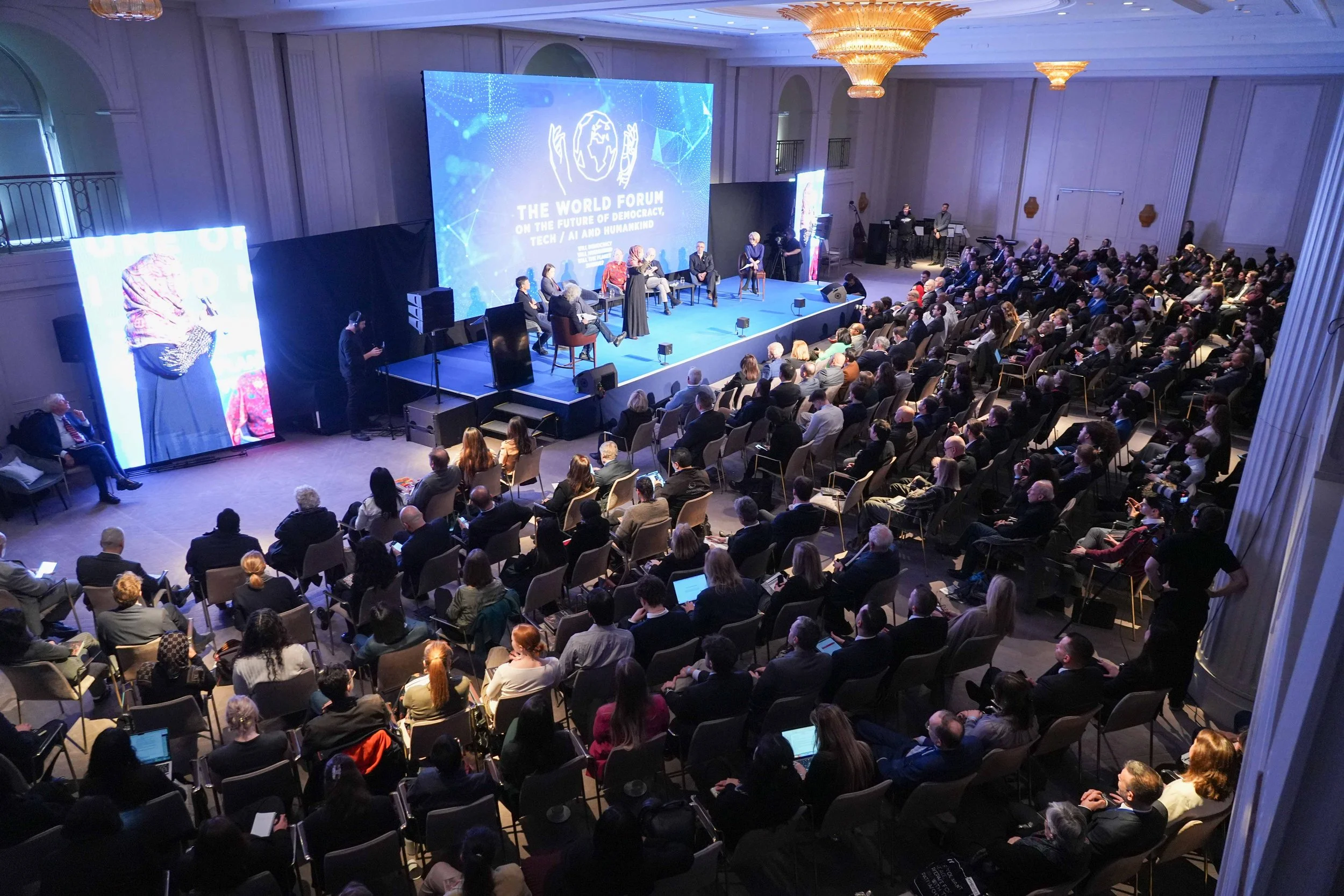
Opening of The World Forum
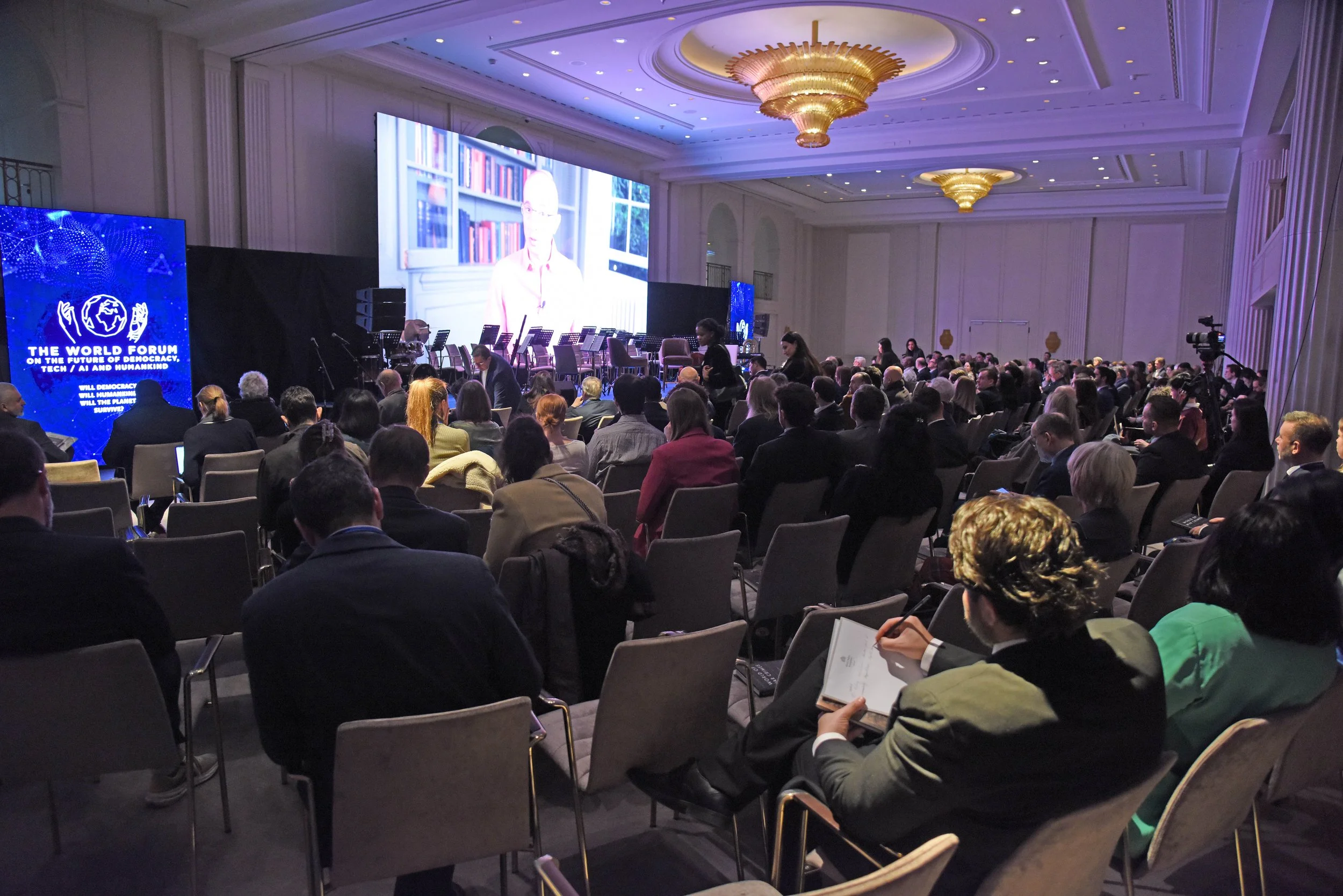
Philosopher Yuval Noah Harari delivers opening remarks at The World Forum
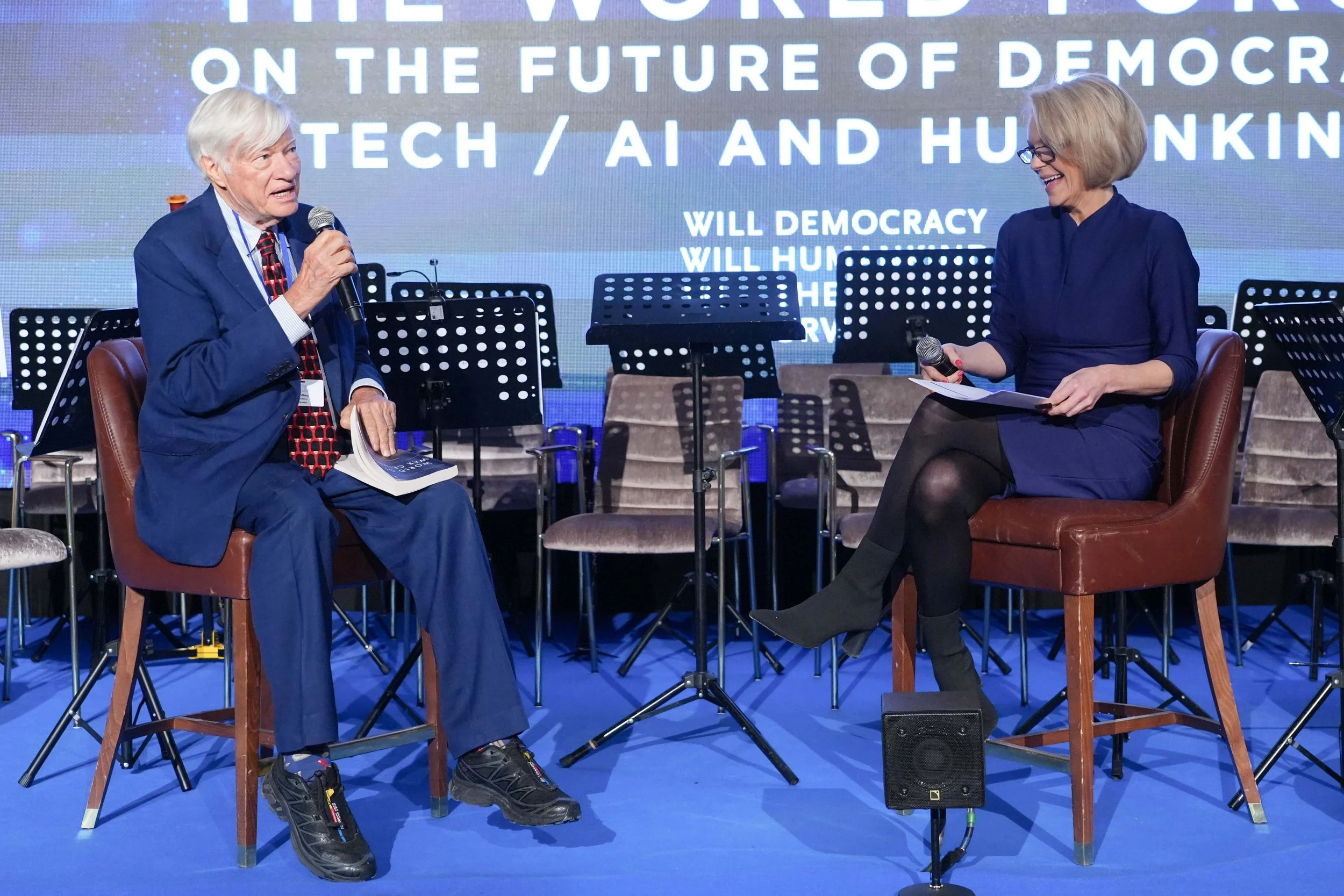
Geoffrey Robertson present the book of
“World of War Crimes”
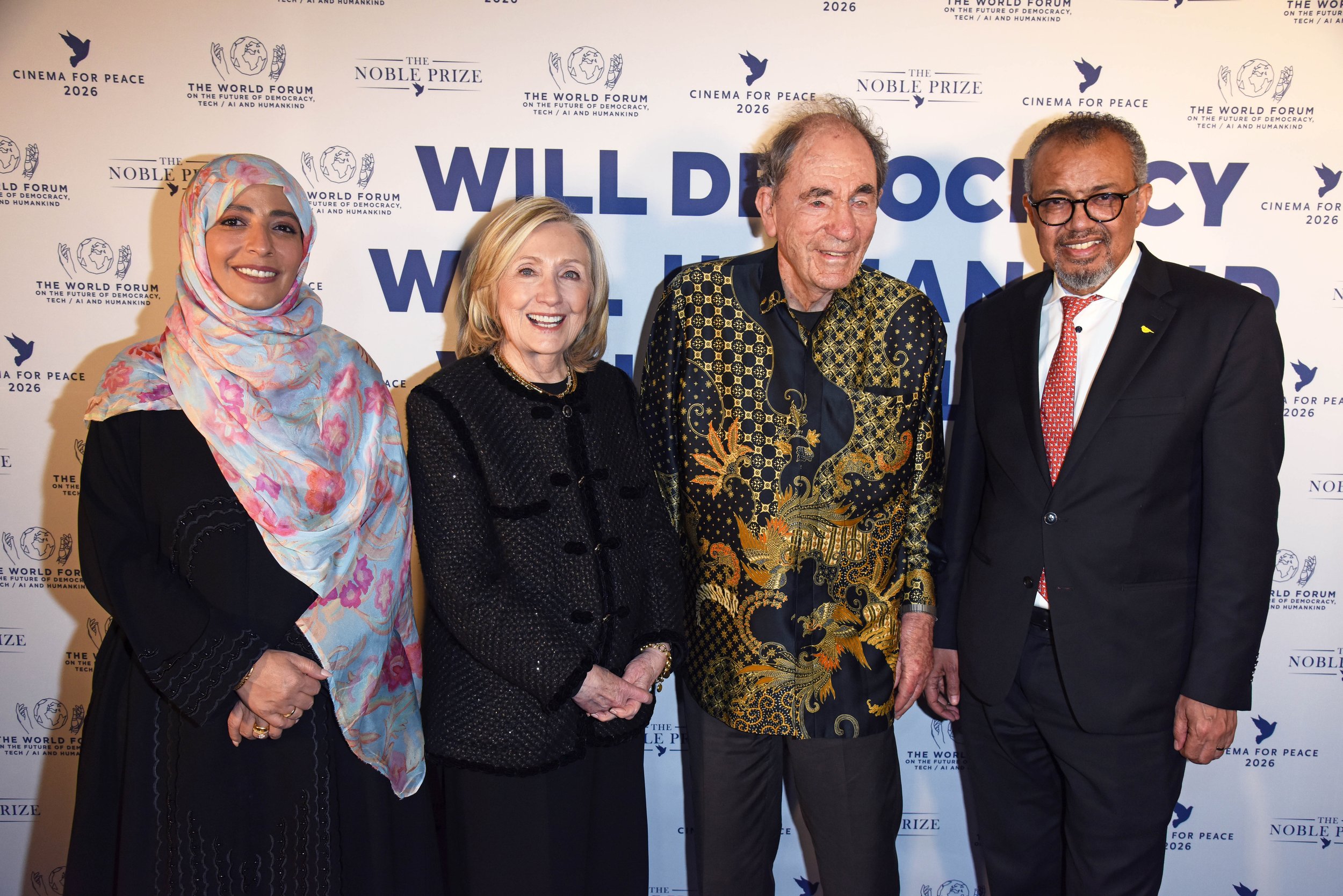
Nobel laureate Karman, Secretary Clinton, Albie Sachs, President of WHO Dr. Tedros
THE NOBLE PRIZE FOR GUARDIANS OF DEMOCRACY
The Cinema for Peace and The World Forum presented The Noble Prize for Guardians of Democracy
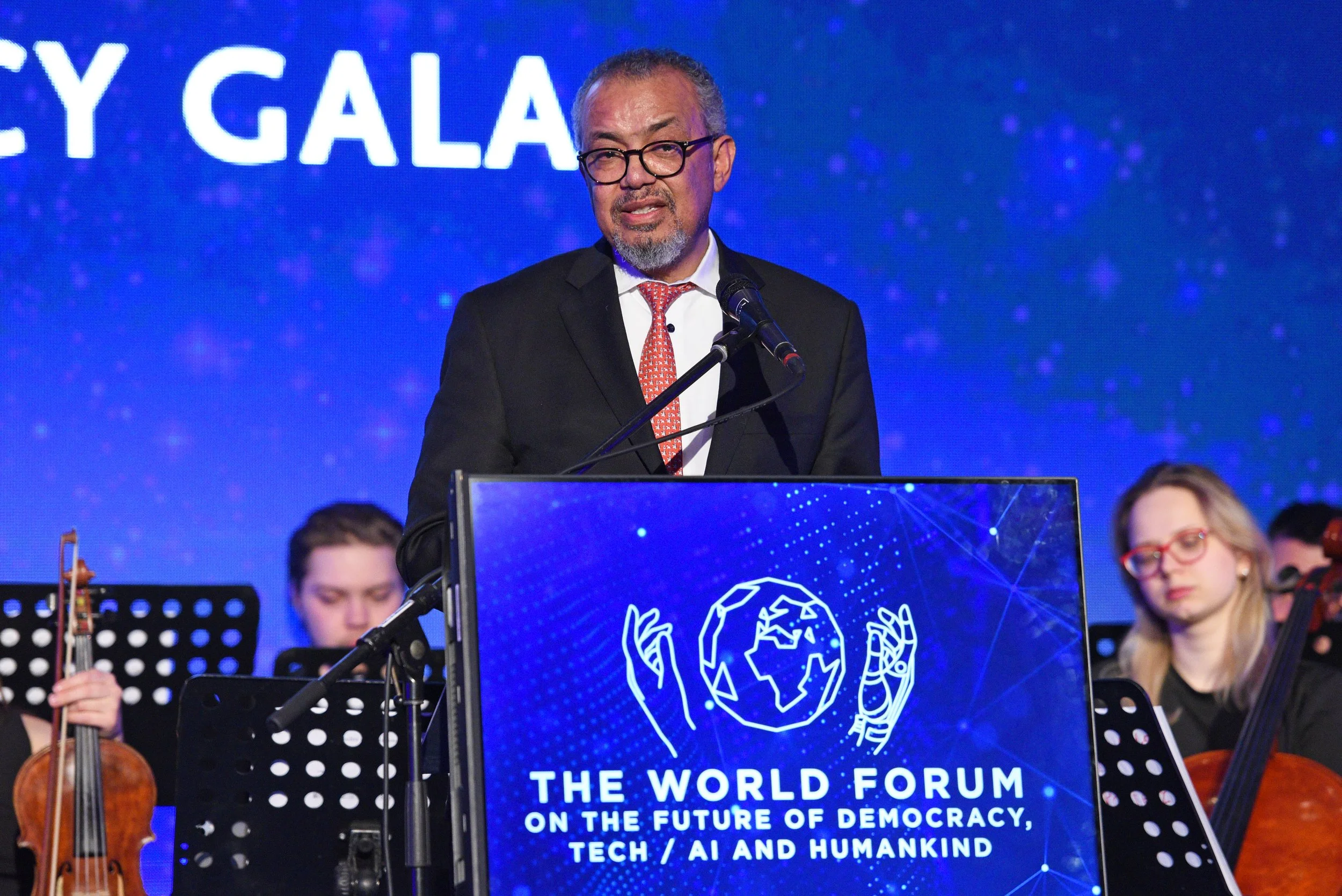
Dr. Tedros & World Health Organisation receive
The Noble Prize - for saving hundreds of millions of lives and protecting humanity from the next pandemic. From coordinating responses to Ebola and COVID-19, to expanding access to life-saving vaccines in the world's most vulnerable communities, Dr. Tedros and the WHO represent global solidarity at its most essential.
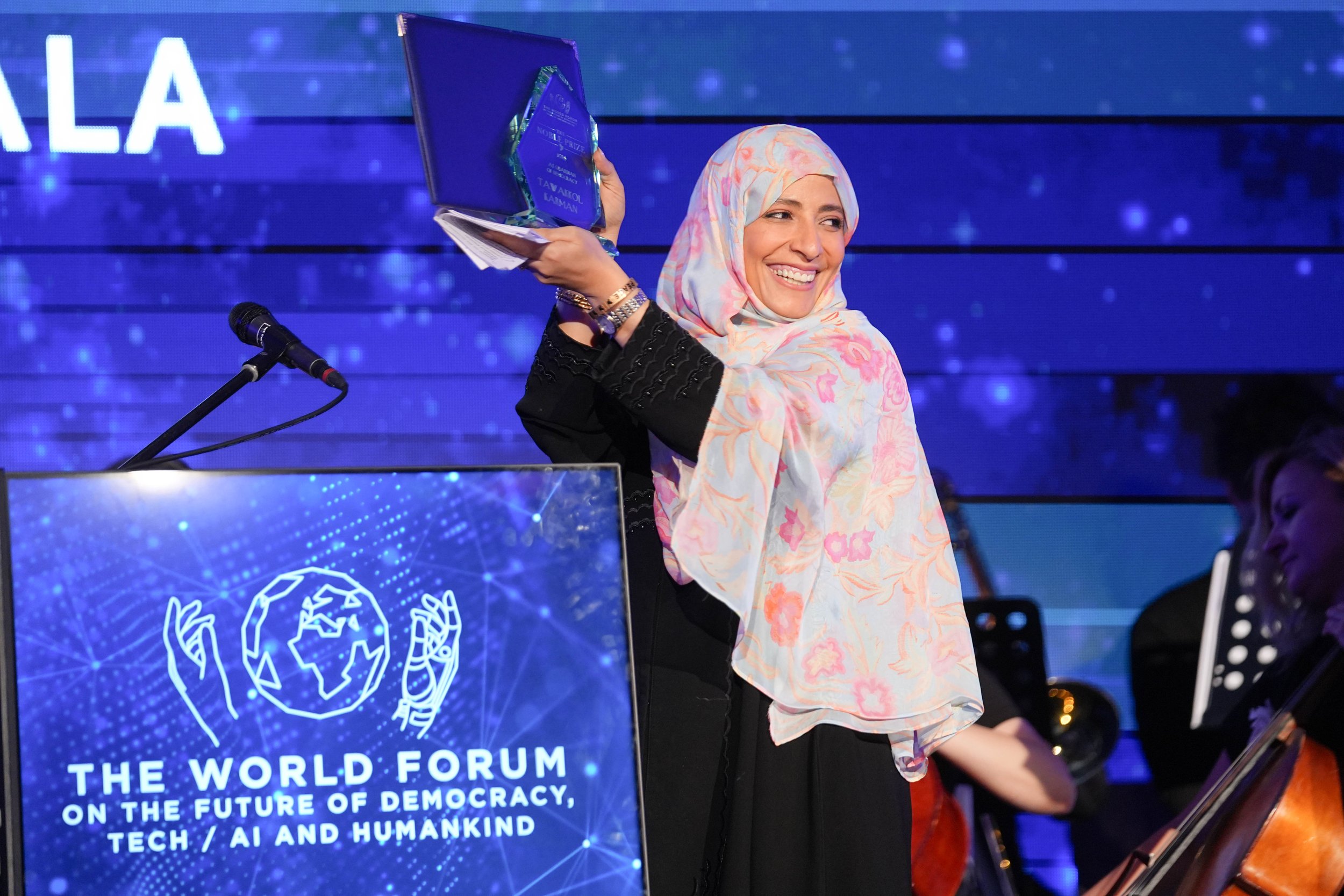
Tawakkol Karman receives The Noble Prize - her non-violent struggle for the safety of women and for women's rights to full participation in peace-building work. A fearless journalist, human rights champion, and founder of Women Journalists Without Chains, she stood firmly for press freedom, civil rights, and the power of non-violent change through her leadership during the Arab Spring. In 2011, she became a co-recipient of the Nobel Peace Prize - the first Arab woman, the first Yemeni, and one of the youngest laureates in history.
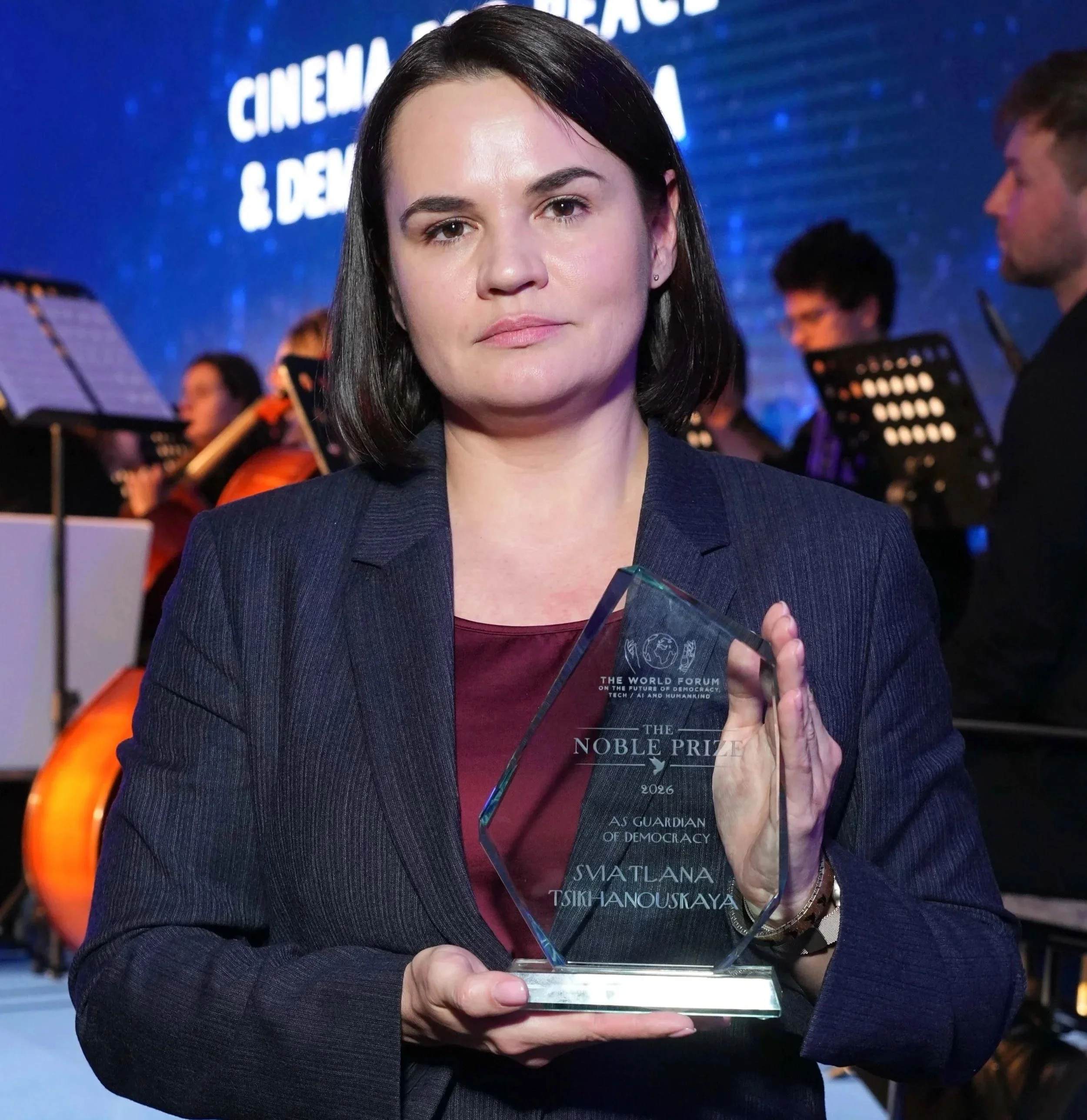
Sviatlana Tsikhanouskaya receives The Noble Prize - for her courageous leadership of the Belarusian democratic movement and her peaceful resistance against the authoritarian regime of Lukashenko. After her husband was unjustly imprisoned for voicing his presidential aspirations, she stepped forward as the main opposition candidate in Belarus's 2020 presidential election. Following a disputed vote and historic mass protests, she was forced into exile, yet refused to let distance silence her voice. From abroad, she continues to champion free and fair elections and democratic reform for her people.
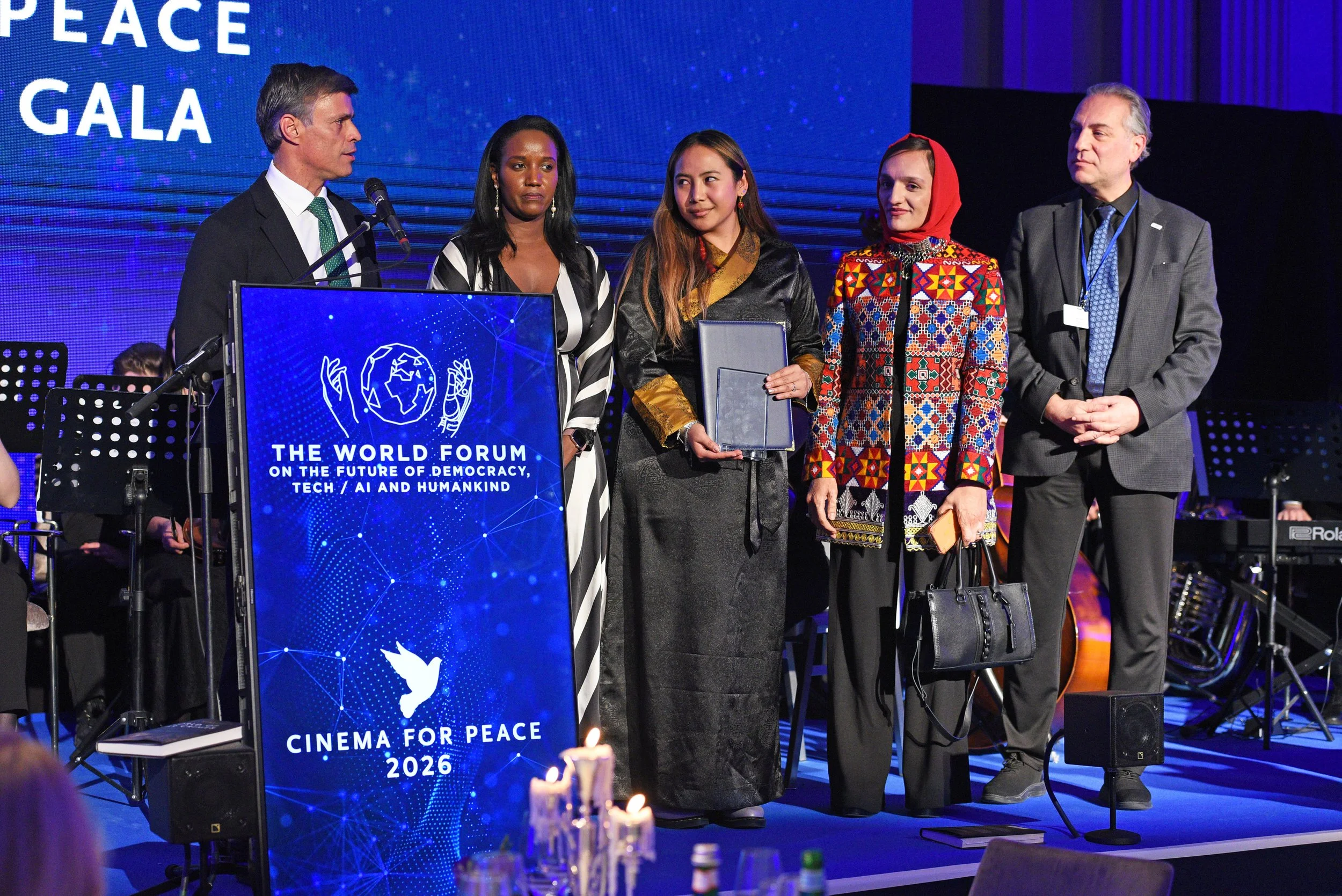
Leopoldo Lopez & World Liberty Congress receive The Noble Prize - for their unwavering defiance of authoritarianism and their work uniting democracy activists across the globe. Venezuelan opposition leader Leopoldo López endured years of unjust imprisonment for his refusal to abandon the cause of democracy. Tonight, the award was presented jointly to him and to The World Liberty Congress, the international movement he helped forge, uniting democracy activists, dissidents, and freedom fighters from across the globe in a shared front against authoritarianism. Their presence in the room together was itself an act of defiance.
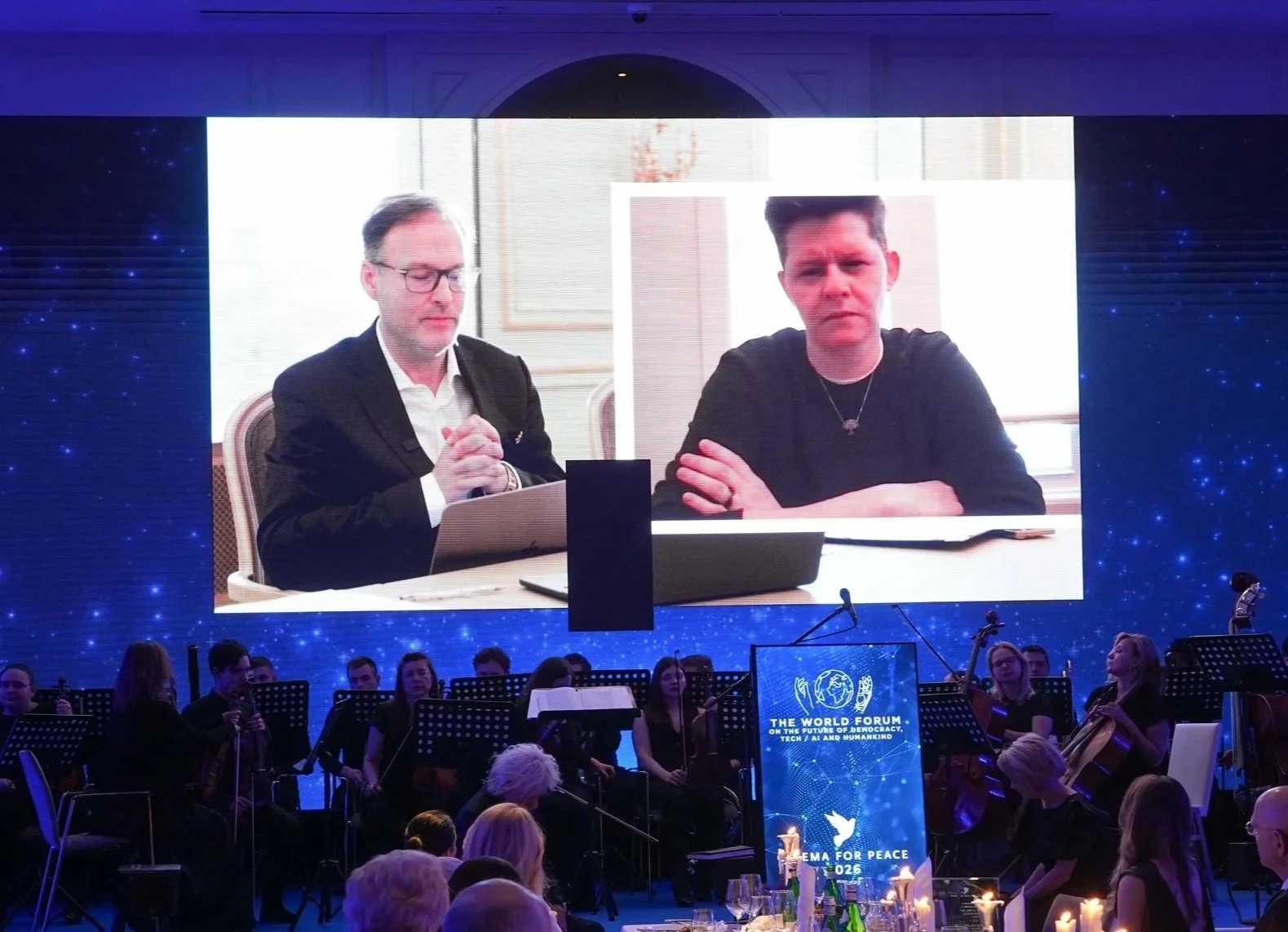
Becca Good receives The Noble Prize on behalf of Renée Good - the most deeply moving moment of the evening, a final honor was dedicated to Renée Good, a mother of three, she was simply taking her six-year-old to kindergarten when she was shot dead by ICE agents in Minneapolis. Her widow, Becca Good, spoke to Cinema for Peace founder Jaka Bizilj in what became her first public conversation since the killing. Hundreds of news outlets, broadcasters, and organizations around the world had asked to speak with Becca. She chose The World Forum and Cinema for Peace.
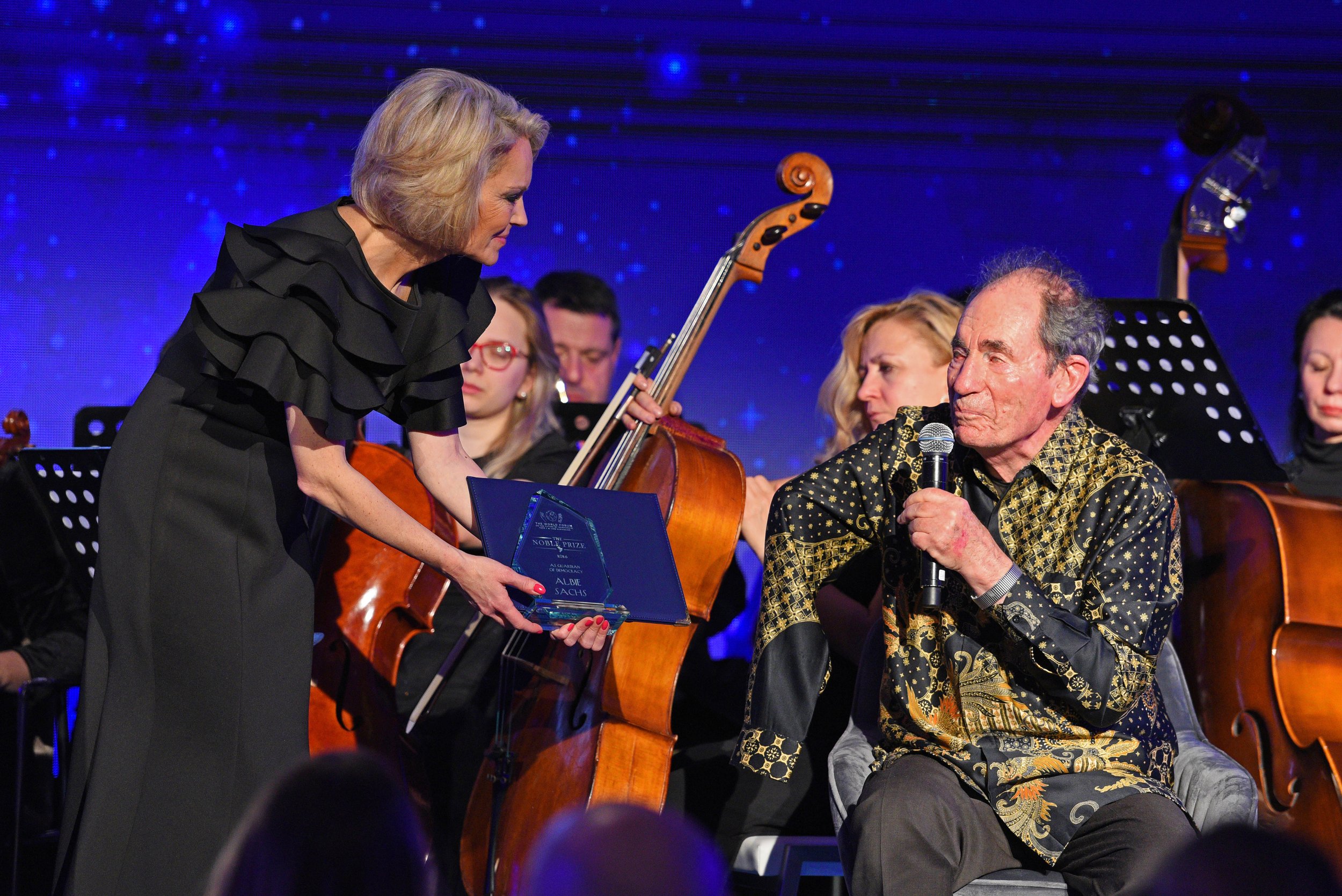
Albie Sachs receives The Noble Prize - for his extraordinary commitment to reconciliation and restorative justice. An anti-apartheid activist who paid a devastating personal price for his resistance, surviving a brutal car bombing carried out by the apartheid regime, he chose not to answer violence with vengeance. Instead, he dedicated his life to building a society rooted in dignity, equality, and justice, and helped write one of the most celebrated constitutions in the world.