
Can humanity become a multi-planetary species without learning to work together on Earth first?
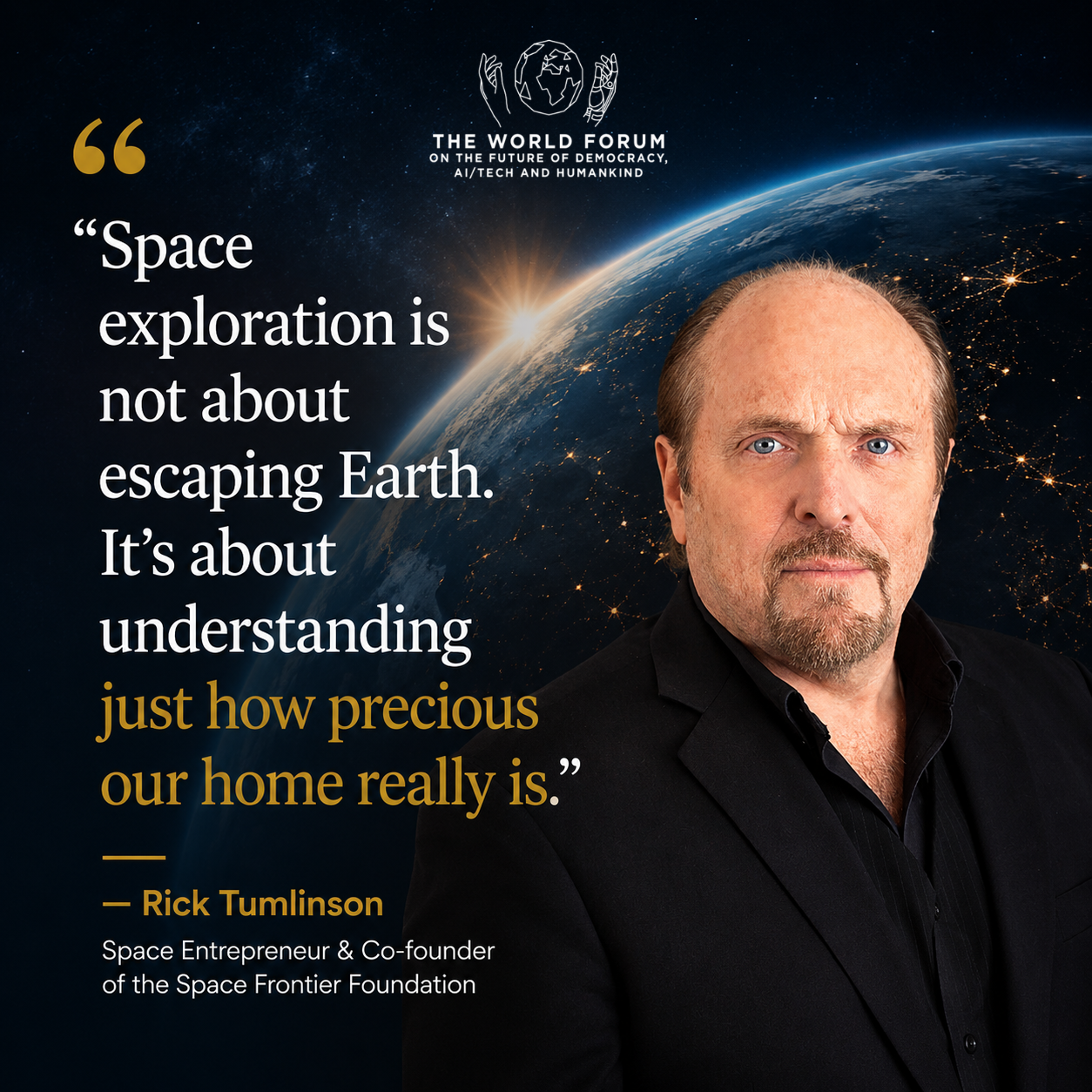
As global competition over the Moon, Mars, and the future of space intensifies, an important question emerges: will humanity carry its conflicts into space—or use this new frontier to build greater cooperation?
Speaking at the World Forum 2026 in Berlin during the panel "Plan B: Arche Noahs under Earth, on the Moon and Mars?", Rick Tumlinson—Space Entrepreneur and Co-founder of the Space Frontier Foundation —argued that space exploration should not be about escaping Earth, but about gaining a deeper appreciation of it. Drawing on the Overview Effect experienced by astronauts, he emphasized that our planet is an irreplaceable home and that future lunar and Martian settlements will depend on cooperation, sustainability, and shared responsibility.
His message extends beyond space exploration. As geopolitical rivalry increasingly reaches beyond Earth, humanity faces a choice: compete for new worlds—or build them together.
Can space become the place where humanity finally learns to cooperate beyond borders?
The Race to Space: Who will control global communication and satellites?
In one of the World Forum 2026's most forward-looking discussions, space entrepreneur Rick Tumlinson, Moon Express co-founder Bob Richards, Space Pharma founder Yossi Yamin, and moderator Jamie Metzl examined a question that is rapidly becoming central to democracy, security, and global governance: who will control the infrastructure of space—and, with it, the future of communications, information, and human civilization? The panel argued that space is no longer a distant frontier but the invisible operating system of modern life, with every GPS signal, financial transaction, military operation, and digital communication depending on satellites. Yet while commercial innovation has transformed access to space, governance has failed to keep pace. The discussion warned that low-Earth orbit is increasingly governed by market power rather than international law, allowing a handful of private actors and competing states to shape access to critical infrastructure with profound implications for democracy, sovereignty, and global stability.
The conversation explored the accelerating risks posed by satellite monopolisation, orbital congestion, space debris, anti-satellite weapons, and geopolitical competition, highlighting how conflicts on Earth are already extending into space. At the same time, the panel emphasized that space also represents humanity's greatest opportunity for scientific progress and economic transformation—from pharmaceutical research in microgravity and space-based solar power to lunar resources capable of supporting a sustainable space economy. Speakers argued that the future will be determined not only by technological breakthroughs but by the governance choices made today. They called for the creation of a World Space Traffic Management Authority, stronger international regulation of low-Earth orbit, democratic oversight of critical satellite infrastructure, inclusion of all major spacefaring nations in governance frameworks, responsible management of orbital debris, accelerated sovereign satellite capabilities for democratic nations, and globally agreed rules for lunar resource governance. Echoing the cooperative spirit that built the International Space Station, the panel concluded that humanity faces a defining choice: whether space becomes an arena of conflict and unchecked competition or a shared domain of peaceful innovation, scientific discovery, and international collaboration that benefits all humankind.
THE UNIVERSAL COMPACT OF OUTER SPACE
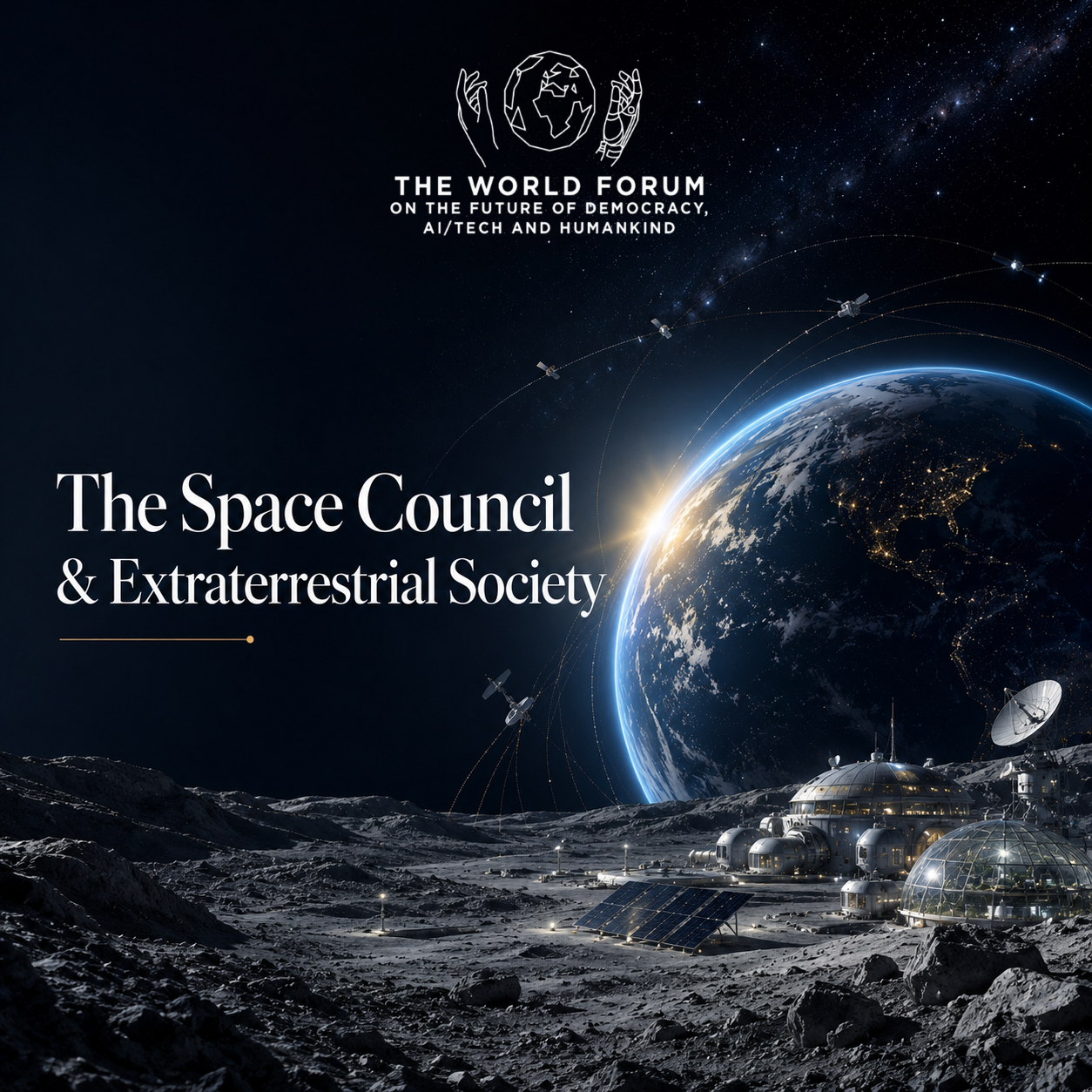
As humanity enters a new era of space exploration, commercialization, and permanent settlement beyond Earth, the World Forum proposes the establishment of a Space Council & Extraterrestrial Society alongside the Universal Compact of Outer Space—a visionary framework designed to shape the ethical, legal, and democratic foundations of humanity's future in space.
The proposal calls for a citizen-centered model of space governance, recognizing outer space as the shared heritage of humanity rather than the domain of governments or corporations alone. It outlines principles for self-governance, human rights in space, responsible resource use, environmental stewardship, space traffic management, and peaceful international cooperation, while proposing institutions such as a Universal Space Council and a Universal Space Navigation and Launch Authority (USNLA) to coordinate safe and sustainable activity beyond Earth.
The initiative also envisions a global network of leaders from space exploration, science, technology, policy, business, culture, and the arts to help guide humanity's expansion into the cosmos. Together, these proposals seek to ensure that the next chapter of civilization is built on freedom, responsibility, innovation, sustainability, and shared human values, providing a long-term blueprint for governance as humanity becomes a multi-planetary species.