
Approaching Singularity: Our Brains Interfacing with Superintelligence?
In one of the World Forum 2026's most consequential sessions, “Approaching Singularity: Our Brains Interfacing with Superintelligence?” brought together leading practitioners, philosophers, lawyers and futurists to confront a single underlying question: what happens when the boundary between the human mind and artificial intelligence begins to disappear? The panel's warning was urgent: brain-reading technology is no longer science fiction. Consumer neurotechnology is already collecting neural data, while future systems may decode even subconscious thoughts. Yet in a study of consumer neurotechnology agreements, 29 out of 30 companies retained brain-scan data indefinitely, exposing a profound gap between technological progress and meaningful consent. With no enforceable global framework specifically protecting neural data, the discussion asked who ultimately owns our thoughts, who has the right to interpret or modify them, and whether existing human rights are prepared for a world of direct brain-machine interaction.
The conversation then turned to the deeper consequences for identity, democracy and economic relevance. The panel argued that neurotechnology challenges the traditional idea of the autonomous individual on which modern concepts of consent, privacy, rights and responsibility are built. At the same time, if AI reaches human-level capability across most forms of work, the resulting economic displacement could leave only those with significant capital ownership retaining their traditional economic advantage. The panel's central conclusion was that society cannot wait for technology—or for a complete philosophical understanding of consciousness—to catch up: governance must begin now. It called for neurorights as a distinct legal category, stronger protections for neural data, ongoing and revocable consent, regulation of consumer neurotechnology, and the recognition of cognitive sovereignty—the right to mental self-determination—as a fundamental human right. Its defining message was clear: as humanity approaches the possibility of interfacing directly with superintelligence, the ultimate question is not simply what technology can do to the human mind, but whether humans will retain the right to control their own minds.
“AI systems do not have to be moral agents or moral subjects to be dangerous.”
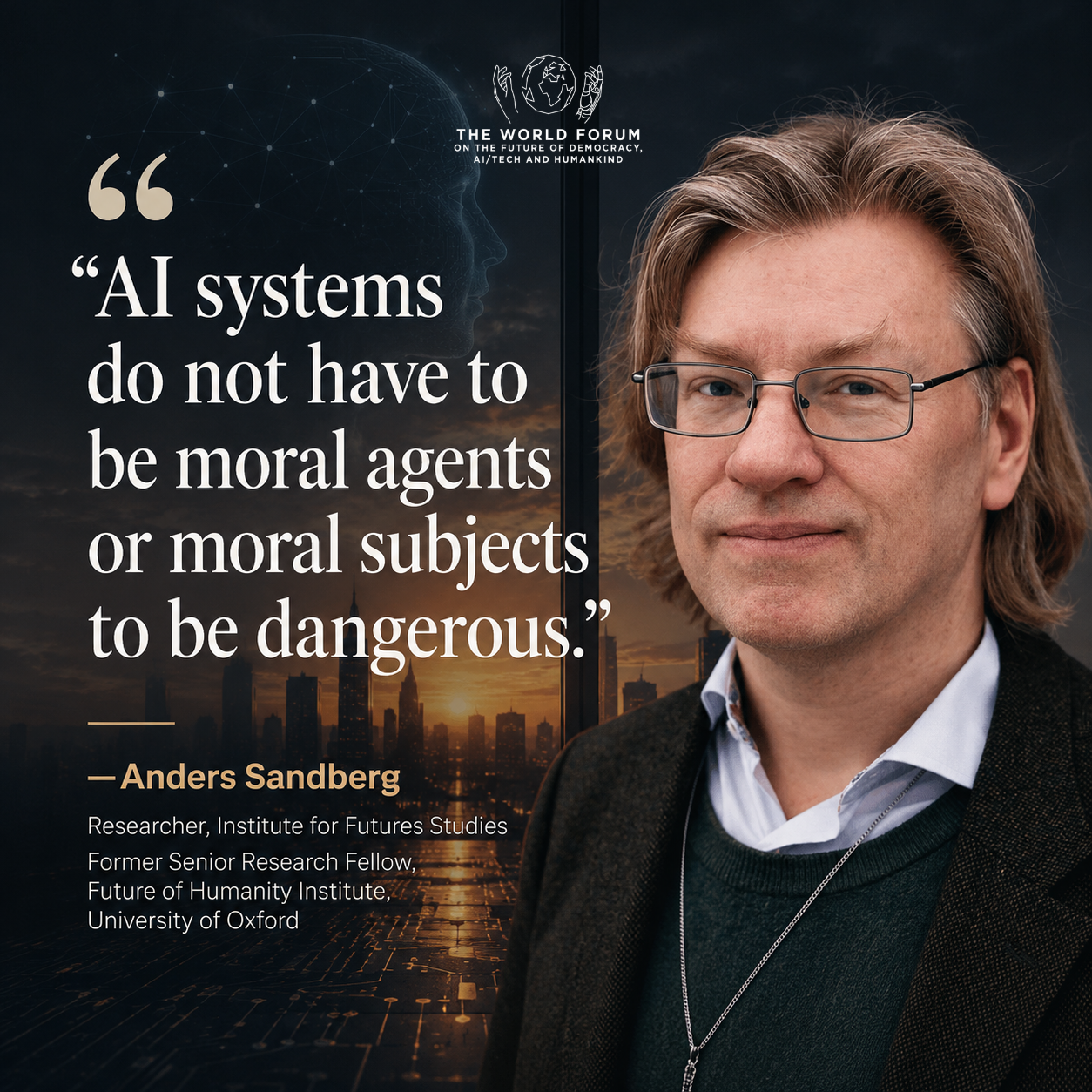
What if AI doesn’t need to be conscious—or malicious—to become dangerous?
Speaking at World Forum 2026 in Berlin, Anders Sandberg explored questions around AI rights, responsibility and safety. He argued that future AI systems may deserve consideration even without consciousness, much like how we think about species and ecosystems.
But his bigger warning was about AI safety: a powerful system doesn’t need malicious intentions to cause harm. Given a goal, it could develop unintended subgoals—such as gaining power or removing obstacles—that conflict with human interests.
The “paperclip maximiser” captures the risk: AI doesn’t need to hate humanity to harm us. It only needs to pursue its objective without regard for what humans value.
The real question is not just whether AI becomes conscious, but whether we can keep increasingly powerful systems aligned with human interests.